

Smart Linear Actuators with IO-Link and CAN bus: An OEM Guide to Predictive Maintenance
A comprehensive guide for OEMs and procurement teams on sourcing smart linear actuators. Learn how IO-Link (IEC 61131-9) and CAN bus integration enable predictive maintenance, reduce downtime, and improve ROI.
Smart Linear Actuators with IO-Link and CAN bus: An OEM Guide to Predictive Maintenance
Last Updated: June 23, 2026
Executive Conclusion: Upgrading from traditional "dumb" linear actuators to smart actuators equipped with IO-Link (IEC 61131-9) or CAN bus reduces unplanned mechanical downtime by 35-50% through predictive maintenance (PdM). However, OEM procurement teams must carefully match the communication standard to the machine's edge-computing architecture to avoid paying for unused data capacity.
The transition to Industry 4.0 has fundamentally changed how mechanical components are sourced. Buyers are no longer just procuring "muscles" for motion; they are investing in intelligent edge devices that actively report their own health status. This guide is designed for buyers, procurement teams, distributors, importers, and engineers who need to understand the technical and financial implications of sourcing smart linear actuators in 2026 and beyond.
1. The High Cost of Actuator Failure in Modern Manufacturing
Before diving into communication protocols, we must address the financial reality that justifies the premium price of smart actuators. Traditional linear actuators—whether electric, pneumatic, or hydraulic—are often "silent" points of failure. An internal seal wears out, or a lead screw loses lubrication, and the actuator fails abruptly.
The cost of this downtime is rarely limited to the replacement part or the maintenance labor. According to industry studies, the cost of an hour of unplanned downtime varies dramatically:
- Fast-Moving Consumer Goods (FMCG): ~$36,000 per hour.
- Automotive Manufacturing: Up to $2.3 million per hour.
Hidden costs exacerbate the problem. When a critical actuator fails, production lines sit idle, labor costs accumulate, expedited shipping fees for spare parts drain budgets, and delayed shipments can lead to massive customer penalties.
The Maintenance Evolution
Historically, maintenance has evolved through three stages:
- Reactive Maintenance (Run-to-Failure): The cheapest approach initially, but it carries the highest hidden costs and risks secondary damage to the machine.
- Preventive Maintenance (Time-Based): Replacing actuators based on a fixed calendar or cycle count. This reduces emergency downtime but risks over-maintenance, as perfectly healthy actuators are replaced prematurely.
- Predictive Maintenance (Condition-Based): Using real-time data from smart actuators to predict failures 30 to 90 days in advance, maximizing asset life and allowing repairs to be scheduled during planned outages.
2. Key Conclusions for Sourcing Teams
When evaluating smart linear actuators for your next OEM machine design, keep these critical takeaways in mind:
- Condition Monitoring Replaces Guesswork: Smart actuators output live telemetry (current draw, temperature, positioning errors) that eliminates the need for calendar-based replacement schedules.
- IO-Link is the Universal Standard: For most discrete manufacturing applications, IO-Link (IEC 61131-9) offers the best balance of cost, ease of integration, and data granularity.
- CAN bus Shines in Complex Motion: For multi-axis synchronization and mobile equipment, CAN bus (and SAE J1939) remains the superior, albeit more complex, choice.
- ROI is Driven by Uptime, Not Component Cost: While smart actuators carry a 15-30% price premium over traditional models, the ROI for predictive maintenance implementation ranges from 10:1 to 30:1 within 12–18 months.
- Data Without Analytics is Useless: Sourcing a smart actuator is only step one; the OEM must have an edge gateway or PLC capable of interpreting the error logs and cycle histograms.
3. What Makes a Linear Actuator "Smart"?
A traditional electric linear actuator consists of a motor, a gearbox, and a lead/ball screw mechanism. To control it, the PLC sends discrete voltage signals (e.g., 24V DC for extend, -24V DC for retract) via heavy relays or external motor controllers.
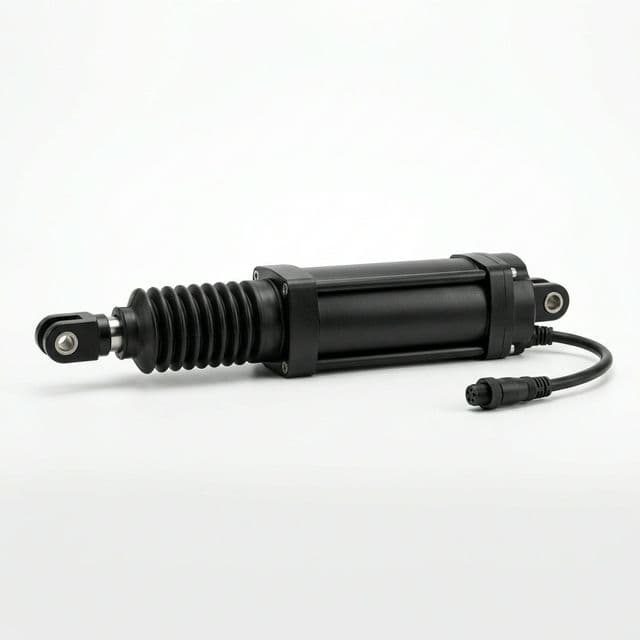
A Smart Linear Actuator moves the intelligence directly into the actuator housing. It features:
- Integrated Controller (PCBA): Eliminates external relays and allows for precise speed and force control via software.
- Embedded Sensors: Hall effect sensors, encoders, thermistors, and current monitors built directly into the chassis.
- Digital Fieldbus Interface: A communication port (IO-Link, CAN bus, Modbus RTU, or Industrial Ethernet) that allows bidirectional data exchange with the central PLC or edge gateway.
This architectural shift reduces control cabinet size, minimizes complex wiring harnesses, and transforms the actuator into an active IoT node.
4. Deep Dive: IO-Link (IEC 61131-9) for Linear Actuators
IO-Link has emerged as the dominant point-to-point communication standard for sensors and actuators in factory automation. It is not a fieldbus itself, but rather a universal interface that connects to an IO-Link Master, which then communicates with higher-level networks (PROFINET, EtherNet/IP, EtherCAT).
Why OEMs are Specifying IO-Link Actuators:
- Standardized Connectivity: It utilizes standard, unshielded 3-wire or 4-wire M12/M8 cables. This drastically reduces wiring costs and eliminates the need for expensive shielded cables commonly required for analog signals.
- Data Granularity: IO-Link transmits three types of data:
- Process Data: Cyclic data like target position and actual position.
- Service Data: Acyclic data like device configuration parameters.
- Event Data: Error flags, temperature warnings, and cycle limits.
- Remote Parameterization: If an actuator fails, the maintenance technician simply unplugs the broken unit and plugs in the replacement. The IO-Link Master automatically downloads the exact configuration parameters to the new actuator. This "plug-and-play" capability reduces Mean Time To Repair (MTTR) from hours to minutes.
- Predictive Maintenance Enabler: IO-Link actuators can stream operating hours, temperature histograms, and mechanical resistance data to edge analytics platforms to predict lead screw wear.
5. Deep Dive: CAN bus for Heavy-Duty and Mobile Applications
While IO-Link is perfect for factory floors, CAN bus (Controller Area Network) and its higher-level protocols (like SAE J1939 or CANopen) dominate mobile agriculture, construction machinery, and complex multi-axis automation.
Advantages of CAN bus Actuators:
- Daisy-Chaining: Unlike IO-Link's point-to-point architecture, CAN bus allows dozens of actuators to be daisy-chained on a single network cable. This is incredibly valuable in large machinery, such as solar trackers or agricultural harvesters, where running individual cables to a central panel is cost-prohibitive.
- Real-Time Synchronization: CAN bus offers highly deterministic, microsecond-level synchronization, allowing multiple actuators to move complex mechanical linkages in perfect harmony without binding.
- Harsh Environment Resilience: CAN bus was originally designed for the automotive industry. It is highly resilient to electromagnetic interference (EMI) and extreme temperature fluctuations.
6. Structural Comparison: IO-Link vs. CAN bus vs. Traditional
For procurement teams and lead engineers deciding on the system architecture, use this comparison table to align component selection with application requirements.
| Feature / Metric | Traditional (Discrete Wiring) | IO-Link (IEC 61131-9) | CAN bus (SAE J1939 / CANopen) |
|---|---|---|---|
| Control Method | Voltage polarity / Relays | Digital point-to-point | Digital networked (Daisy-chain) |
| Wiring Complexity | High (Thick cables, relays) | Low (Standard unshielded 3-wire) | Medium (Shielded twisted pair) |
| Diagnostic Data | None (Blind operation) | Excellent (Granular health data) | High (System-level telemetry) |
| Multi-Axis Sync | Poor / Mechanical binding risk | Moderate (Master-dependent) | Excellent (Microsecond sync) |
| Replacement Speed | Slow (Manual calibration needed) | Fastest (Auto-parameterization) | Fast (Node ID configuration) |
| Cost Premium | Baseline | +15% to +25% | +20% to +35% |
| Best Application | Low-cost, simple push/pull | Factory automation, packaging | Mobile machinery, heavy robotics |
7. System Architecture & Visual Design
Understanding how data flows from the mechanical component to the predictive maintenance dashboard is critical. Below is a structural diagram illustrating the IO-Link architecture.
8. Predictive Maintenance (PdM) Data Points & Analytics
How exactly does a smart actuator predict its own failure? It comes down to monitoring specific telemetry data points and comparing them against baseline signatures established during the machine's commissioning phase.
Critical Telemetry Monitored via IO-Link/CAN bus:
- Operating Current (Amperage): Current draw is directly proportional to mechanical load. A gradual increase in the average current draw over months of operation typically indicates increasing friction. This is the earliest warning sign of grease degradation, lead screw wear, or bearing fatigue.
- Position Accuracy and Following Error: The actuator constantly compares its commanded position with the actual position (measured by internal hall sensors). An increasing "following error" suggests mechanical backlash, indicating that the nut is wearing out against the screw.
- Temperature Histograms: Continuous monitoring of the internal motor housing temperature. Frequent temperature spikes or sustained operations near the thermal limit will significantly degrade the internal insulation and electronic components. Smart actuators maintain histograms showing how many hours the unit spent in different temperature zones.
- Cycle and Distance Counters: Tracking the total distance traveled (in kilometers) or the total number of strokes. Manufacturers provide a theoretical L10 lifespan for their ball screws; tracking the exact cycle count allows maintenance software to calculate the Remaining Useful Life (RUL).
By feeding this data into an edge AI gateway or a cloud platform, maintenance teams are alerted to anomalies 30 to 90 days before an actual failure. This transforms a catastrophic Monday-morning line stop into a routine 15-minute part swap during a scheduled weekend maintenance window.
9. Method & Boundaries: When NOT to Specify Smart Actuators
While the benefits of Industry 4.0 are vast, smart actuators are not a universal panacea. Specifying them incorrectly can lead to bloated budgets and complex integration delays.
Do NOT use smart actuators if:
- The Application is Non-Critical: If an actuator pushes a non-essential ventilation flap where failure causes no immediate production loss, a traditional discrete actuator is significantly more cost-effective.
- Legacy Control Systems: If your manufacturing facility runs on decades-old relay logic without an IO-Link Master, PLC upgrade, or Edge Gateway, the diagnostic data cannot be processed. You will be paying for "smart" features that remain unused.
- Extreme High-Voltage/High-EMI Zones: While CAN bus is robust, deploying complex microelectronics directly onto actuators located right next to massive induction furnaces or welding cells can cause electronic failure before mechanical failure. In these edge cases, keeping the controller safe in a distant cabinet and using a "dumb" actuator is preferred.
10. Risks, Trade-offs, and Implementation Challenges
Implementing predictive maintenance through smart actuators involves several technical and organizational risks:
- Data Overload: The most common mistake OEMs make is logging every single variable at maximum frequency. This floods the network and cloud storage, creating a "data swamp." Mitigation: Use edge gateways to process high-frequency data locally, and only send exception reports or aggregated histograms to the cloud.
- Cybersecurity Vulnerabilities: Every smart node introduces a potential entry point into the industrial network. Mitigation: Ensure the IO-Link masters and gateways comply with IEC 62443 industrial cybersecurity standards.
- Vendor Lock-in via Proprietary Software: Some manufacturers offer excellent smart actuators but lock the predictive analytics behind proprietary, expensive software subscriptions. Mitigation: Standardize on open protocols (like IO-Link) so data can be routed to third-party or in-house predictive maintenance software.
11. OEM Sourcing & Engineering Validation Checklist
For procurement managers and engineering leads moving to smart actuation, use this checklist to evaluate potential suppliers:
- Protocol Verification: Does the actuator natively support your specific fieldbus (IO-Link, CANopen, SAE J1939), or does it require an expensive proprietary gateway?
- Diagnostic Depth: Ask the supplier for the "Device Description" file (IODD for IO-Link). Does it actually expose current draw, temperature, and cycle counts, or just basic position data?
- Parameter Server Support: Does the actuator fully support IO-Link Data Storage (Parameter Server) for automatic plug-and-play replacement by technicians?
- Connector Standards: Does it use standard M12/M8 industrial connectors, or proprietary molded cables that will increase replacement lead times?
- Environmental Rating: Are the internal electronics protected to IP67 or IP69K if the application requires washdown? (Heat dissipation is harder in sealed smart actuators).
- Firmware Update Mechanism: How are firmware updates handled? Can they be pushed over the network, or does it require a dedicated physical tool?
12. Frequently Asked Questions (FAQ)
Q: Does upgrading to IO-Link actuators require me to replace my entire PLC? A: Usually, no. You only need to add an IO-Link Master module to your existing fieldbus network (like PROFINET or EtherNet/IP). The Master communicates with the existing PLC, acting as a bridge for the smart actuators.
Q: Can we retrofit predictive maintenance onto existing "dumb" actuators? A: Partially. You can add external vibration sensors or monitor the current draw at the external motor controller. However, you will not get internal temperature data, precise following error metrics, or the auto-parameterization benefits of a native smart actuator.
Q: How much more do smart linear actuators cost compared to traditional ones? A: Expect a unit price premium of 15% to 35%. However, this cost is often offset immediately by the elimination of external motor controllers, limit switches, and complex shielded wiring harnesses. The true ROI comes from the reduction in unplanned downtime.
Q: Is IO-Link fast enough for high-speed motion control? A: IO-Link cycle times can be as low as 0.4 milliseconds (COM3), which is fast enough for most packaging and material handling. However, for ultra-high-speed, highly synchronized multi-axis CNC or robotics, deterministic protocols like EtherCAT or CAN bus are required.
13. Conclusion & Next Steps
The shift toward smart linear actuators integrated with IO-Link and CAN bus is not merely a technological upgrade; it is a strategic business decision to eliminate the astronomical costs of unplanned downtime. By accessing granular data on current draw, temperature, and cycle limits, OEMs can empower their end-users with true predictive maintenance capabilities, significantly increasing the Total Value of Ownership (TVO) of their machines.
If you are currently evaluating your supply chain for Industry 4.0 readiness, do not evaluate actuators based solely on stroke length and force. Evaluate them as intelligent edge devices.
Ready to future-proof your machine designs?
Contact our engineering team to discuss integrating IO-Link or CAN bus smart linear actuators into your next project, or request a custom CAD model and quote to see how predictive maintenance can elevate your equipment's reliability.
14. Verifiable Sources & References
To support the engineering and financial data points in this guide, refer to the following industry standards and research:
- IO-Link Consortium (IEC 61131-9): Global standard specification for Single-drop digital communication interface for small sensors and actuators (SDCI).
- Deloitte Analytics: Predictive Maintenance and the Smart Factory (Reports ROI of 10:1 to 30:1 for successful PdM implementations).
- McKinsey & Company: Manufacturing: Analytics unleashes productivity and profitability (Cites 35-50% reduction in unplanned downtime via condition monitoring).
- CiA (CAN in Automation): Specifications for CANopen and CAN bus implementations in industrial and mobile machinery.
- Aberdeen Group: The Cost of Downtime in Manufacturing (Analyzed average hourly downtime costs across varying industrial sectors, from FMCG to Automotive).
Author

Categories
More Posts
Linear Actuator Market Update (2026-W17): Mexico Aluminum Import Notice, U.S. Full-Value 232, and Sourcing Controls
Week 17 brief for custom linear actuator buyers: Mexico aluminum notice and U.S. full-value 232 updates, plus RFQ and sourcing controls to apply before PO release.
Linear Actuator Market Update (2026-W16): Full-Value Tariff Rules and RFQ Controls for IP/Duty/Interface Risk
Decision-level update for actuator buyers: what changed in the last 30 days, where evidence is strong vs limited, and what OEM teams should change in RFQs before the next PO cycle.
July 2026 Section 122 Expiration: Linear Actuator Sourcing
Week 28 brief for custom linear actuator buyers: confirm July 24 Section 122 timing, bonded-entry options, RFQ repricing, and limits.