
110V/120V AC linear actuator guide with a 1000 lb fit checker
If you searched for a 1000 lb 110v linear actuator or a 110v actuators 24 in stroke request, or a 110v ac linear actuator or a 120v linear actuator query (including 110v ac linear actuator in stock and 110v ac linear actuator wholesale), use the checker first. It tells you whether a 110/120 VAC catalog package is realistic, whether near-term stock is likely or quote-only, whether you need a true AC actuator, or whether the same facility power should feed a DC actuator system instead.
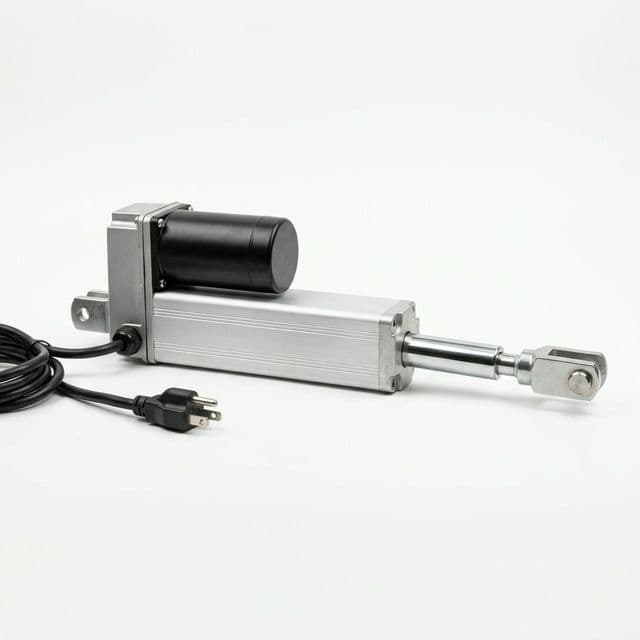
Visual reference: 110V AC actuator package reviewed in this guide
Quick verdict
Direct AC needs review
The alias is plausible, but stock and model confirmation are required.
Default scenario
This is the built-in 1000 lb screening example, not a personalized result yet.
Edit the inputs below, then rerun the checker.
Current result: Direct AC needs review. The alias is plausible, but the margin is thin enough to require supplier confirmation.
A 1000 lb 110v linear actuator can be the right intent, yet the request sits close enough to public AC limits that direction of load, stroke, and starts per hour all matter.
Recommended architecture
Keep 110/120 VAC options on the table, but prepare an AC-fed DC fallback if the quote exposes a control or duty gap.
Why the tool says this
You are inside the reviewed 110 V conversation, but not by much. This is where the difference between package-style offers, true-AC offers, push versus pull ratings, and published duty tables decides whether the spec survives.
Next step
Ask for a model-level recommendation with exact stroke, force direction, and starts-per-hour requirements attached.
In-stock screen
Use this result as a fit screen first. The final in-stock answer still depends on a timestamped part-number check and confirmed ship date.
Request live quantity, shipping cutoff, and approved alternates before committing a build date.
Reviewed 110 V pages do not all mean the same thing: Venture FD/VFD is an AC-input package around a DC motor, while Venture SJ45 is a true AC actuator.
As of 2026-04-06, Thomson Electrak GX AC publishes 1 x 115 Vac 4500 N models with up to 24 in stroke, while CMCO TAL 1000 lb 115 VAC standard models publish up to 18 in.
NEMA lists ANSI C84.1-2020 (R2025) as active, and published Table 1 references for nominal 120 V utilization show 114-126 V (Range A) and 110-127 V (Range B). Treat "110V" as nominal-language intent and verify low-line behavior.
As of 2026-04-06, reviewed Thomson Electrak GX 115 VAC part pages show explicit 102-130 VAC at 60 Hz windows, with a 6-to-10-week lead-time spread across nearby SKUs. Keep voltage, frequency, force-by-stroke, and lead time tied to exact model code.
In-stock signals are live and SKU-specific: on 2026-04-05, reviewed listings show "In Stock" and "In Stock (3)" while quote-request and shipping-variation caveats still appear.
Certification scope matters: UL references separate recognized components, listed panels, and complete-product scope, so mark type should be confirmed before installation sign-off.
Venture SJ45 proves a true-AC route can sit above the alias load, while Phoenix Mecano shows that not every AC-capable family reaches the same force level.
Venture FD/VFD adds a second wrinkle by showing that some 110 V offers above 1000 lb are packaged around DC motors. That makes a 1000 lb request a custom-screening case rather than a blind catalog purchase.
The query currently behaves like a buying and screening problem, not a pure explainer article.
This page answers the general 110V query, the 1000 lb variant, the "110v actuators 24 in stroke" alias, the "110v ac linear actuator" alias, and the "110v ac linear actuator in stock" and "110v ac linear actuator wholesale" sub-intents without splitting authority across multiple routes.
Last reviewed 2026-04-23 against the current official source set used by the tool and report.
Direct-AC preference does not remove machine-level scope checks. Confirm whether certification evidence is component-level, panel-level, or complete-product scope before final release.
If direct AC is required, ask for minimum operating voltage and low-line restart behavior. Nominal-voltage naming alone does not confirm field behavior near the lower utilization band.
Do not assume 115 VAC means universal 50/60 Hz compatibility. At least one reviewed 115 VAC family publishes a 60 Hz-specific operating window at part level.
This load is above the 4000 N public benchmark shown on Phoenix Mecano LZ60P, so not every AC-capable industrial family will cover it.
As of 2026-04-06, reviewed Thomson 115 VAC part examples show a 6-to-10-week lead-time spread. Treat sub-4-week plans as unverified until the exact model code and ship date are confirmed.
Core conclusions and key numbers
This section turns the tool output into a decision summary. It keeps the canonical page useful even for buyers who only need a fast screening read.
Current public sources show a true AC actuator above the alias load, an AC-input package above the alias load in push but not in pull, and an AC-capable industrial family below the alias load. The keyword is real enough to answer directly, but it is not specific enough to choose architecture.
As of 2026-04-06, Thomson Electrak GX AC includes 1 × 115 Vac models at 4500 N with up to 24 in stroke, while CMCO TAL 1000 lb 115 VAC standard models stop at 18 in. The alias is valid, but model constraints decide feasibility.
As of 2026-04-05, reviewed listings include "In Stock" and "In Stock (3)" labels while still carrying quote-processing and shipping-variation caveats. Buyers should ask for timestamped stock confirmation and approved substitutes rather than assuming a category-level shelf promise.
The alias "110v ac linear actuator wholesale" maps to the same fit-check logic as the base 110V query. Wholesale intent adds RFQ controls such as MOQ, lot consistency, and split-shipment policy, but force, duty, and architecture screening still decide technical fit.
The reviewed landscape now includes true AC motor actuators, 110/230 VAC input packages built around 12/24 VDC PMDC motors, and AC-fed industrial DC systems. If direct mains wiring at the actuator is non-negotiable, the buyer has to confirm which of those three they are actually buying.
Venture FD/VFD publishes 1300 lb compression and 900 lb tension, while Venture SJ45 publishes up to 5000 N in both push and pull. The decision should stay tied to the exact family and part number rather than to the keyword headline.
As of 2026-04-23, Venture SJ45 page data and Venture VSJ series page data do not present one interchangeable spec set. Treat family-name matching as a discovery step only, then release decisions on the exact model page and datasheet.
The reviewed public set now spans 10%, 15%, 17%, stroke-dependent 20/15/10%, and 45% to 100% duty windows depending on family, stroke, and loading zone. That is better than no data, but it still is not a universal starts-per-hour answer.
IP54, IP66 dynamic, and IP69K static are different procurement classes, not interchangeable waterproof claims. The reviewed sources also show optional motor brakes, internal load-holding brakes, and explicit warnings about side load, shock load, duty overrun, and incorrect wiring.
UL and machine-safety references separate component-level recognition from machine-level electrical compliance. For 110V projects, confirmation should include mark type, panel scope, and machine standard scope instead of relying on a single product listing line.
NEMA shows ANSI C84.1-2020 (R2025) as active, and published Table 1 references for nominal 120 V systems show a utilization window. If the RFQ never defines low-line behavior, a direct-AC shortlist can fail late on restart torque or thermal margin.
IEC 60529 and ISO 20653 do not represent the same equipment domain context. If a listing says IP69K without naming the test standard and condition, sealing confidence should stay provisional.
NEMA guidance states IEC 60529 and NEMA Type evaluations are not identical and Table A-1 mapping is one-way. In US procurement, IP claims alone do not close corrosion, icing, oil, and coolant exposure boundaries.
NEMA MG 1 Part 12 shows locked-rotor current and inrush behavior that can be much higher than running current, and also states that operating at ±10% voltage / ±5% frequency limits does not necessarily preserve rated performance. Direct-AC RFQs should include startup current and low-line torque checks, not only steady-state amp assumptions.
As of 2026-04-23, reviewed Thomson Electrak GX 115 VAC part pages show explicit 102-130 VAC at 60 Hz windows and part-level fields such as 2.2 to 2.8 A max current draw, -26 to 65 C ambient limits, and static IP45 with dynamic protection listed as N/A. If the RFQ states voltage without these boundaries, deployment risk stays open.
IEC 60034-30-1:2025 applies IE classes to certain AC motors and excludes DC commutator motors and non-separable integrated motors. For actuator procurement, motor-class wording cannot replace package-level current, thermal, and duty evidence.
Confirm the exact push rating at your 8 in stroke.
Request written starts-per-hour or duty guidance for 12 starts per hour.
Ask for a committed ship date for your 14-day delivery window and document acceptable alternates.
Ask whether the quoted 110/120 VAC offer is a true AC motor actuator, an AC-input package, or an AC-fed DC system.
Ask for the allowable operating-voltage window and low-line restart behavior instead of relying on nominal "110V" naming alone.
Ask for rated line frequency (50/60 Hz) and voltage tolerance at that frequency. Do not assume every 115 VAC SKU is dual-frequency compatible.
Ask whether the actuator includes thermal cutout, brake options, and end-of-stroke protection.
Ask which certification mark applies (recognized component, listed panel, or full product) and request certificate scope in writing.
Verify the official ingress rating, whether it follows IEC 60529 naming, and whether it applies during motion or only in static exposure.
What the source audit changed on this page
This table shows the gaps found in the earlier pass, the official-data fixes added in this round, and the resulting procurement impact.
| Gap found | New verified finding | Decision impact | Sources | Updated |
|---|---|---|---|---|
| The alias phrase "110v actuators 24 in stroke" lacked model-level AC evidence for where 24 in is feasible at 1000 lb versus where it is not. | As of 2026-04-06, Thomson Electrak GX AC publishes 1 × 115 Vac models at 4500 N (1000 lbf) with max ordering stroke 24 in and 25% full-load duty at 25 C, but with model limits (21B5 not above 20 in and 2KB5 not above 12 in), static IP45, and capacitor requirements. In contrast, CMCO TAL 1000 lb tables for 115 VAC list standard strokes 4, 8, 12, and 18 in with 17.5% duty and 4 A current draw. | Treat 24-inch intent as a model-code screening task, not a category-level assumption. If the project needs 24 in at around 1000 lb on 115 VAC, require exact model code, stroke-specific restrictions, capacitor/start hardware details, and ingress/duty confirmation in writing before approval. | Thomson Electrak GX AC catalog, CMCO TAL Series 1000 lbs | 2026-04-06 |
| The alias "110v ac linear actuator" plus its "in stock" and "wholesale" variants were not answered as one procurement workflow. | As of 2026-04-05, reviewed distributor pages still show mixed procurement signals even when stock labels look positive: Motion LS28-1B5TN-08 shows "In Stock" with quote-request caveat text, Motion LS25-1B5TN-04 also shows "In Stock" with shipping-variation and quote-request caveats, and Flexible Assembly TAL10-1A20-12 shows "In Stock (3)" with same-day shipping cutoff text. | Treat the base alias as an architecture-screening request and treat "in stock" as a timestamped SKU signal instead of a category guarantee. For "wholesale" wording, keep the same canonical engineering screen and add MOQ, lot-consistency, and ship-window checks in the RFQ. | Motion LS28-1B5TN-08, Motion LS25-1B5TN-04, Flexible Assembly TAL10-1A20-12 | 2026-04-05 |
| The earlier copy treated 110 V as one architecture bucket. | Official pages now reviewed show at least three different meanings: Venture FD/VFD uses 110/230 VAC input power with 12/24 VDC PMDC motors, Venture SJ45 publishes a 115/230 VAC true AC actuator, and Phoenix LZ60P publishes 110/230 VAC or 24/36 VDC drive options. | Ask whether the quoted 110 V product is a true AC motor actuator, an AC-input/DC-output package, or an AC-fed DC subsystem before you freeze the shortlist. | Venture FD/VFD, Venture SJ45, Phoenix Mecano LZ60P | 2026-04-03 |
| The page did not define a standards-backed voltage window for 110V versus 120V language. | NEMA shows ANSI C84.1-2020 (R2025) as active, and USDA Bulletin 1724D-114 reproduces ANSI C84.1 Table 1 values for 120 V systems: utilization Range A 114 to 126 V and utilization Range B 110 to 127 V. | Treat "110V" search language as a nominal-voltage shorthand, not an exact operating point. RFQs should request allowable input window and low-line behavior, not only "110V" in the headline. | NEMA ANSI C84.1-2020 (R2025), USDA Bulletin 1724D-114 Table 1 | 2026-04-05 |
| Duty-cycle language was too generic for procurement use. | Public data is now anchored to specific families: Venture FD/VFD lists 10% typical duty, Venture SJ45 lists 17%, Phoenix LZ60P lists 15%, LINAK LA36 data sheet lists 20% to 600 mm then 15% to 999 mm and 10% to 1200 mm at 40 C, and Thomson Electrak XD lists 45% full-load duty at 25 C with operating zones that can reach 100%. | Starts per hour and stroke must be checked against a named family and temperature assumption. Heavy duty is not a substitute for a thermal profile. | Venture FD/VFD, Venture SJ45, Phoenix Mecano LZ60P, LINAK LA36 data sheet, Thomson Electrak XD | 2026-04-03 |
| Outdoor and washdown wording lacked a standards boundary. | The reviewed source set spans materially different enclosure claims: Phoenix LZ60P is IP54, LINAK LA36 is IP66 dynamic and IP69K static, Thomson Electrak XD is IP66 dynamic with static protection up to IP69K, and IEC 60529 is the governing IP-code classification standard. | Do not treat IP54, IP66 dynamic, and IP69K static as interchangeable. Outdoor and washdown RFQs need the exact rating, test condition, and cable-sealing scope. | Phoenix Mecano LZ60P, LINAK LA36, Thomson Electrak XD, IEC 60529 | 2026-04-03 |
| The page did not define where machine-level electrical standards begin and end. | IEC 60204-1 and NFPA 79 section 1.1.1 both scope machine electrical equipment from the supply-connection point and around the <=1000 VAC / <=1500 VDC class, while IEC 60204-11 scopes equipment above 1000 VAC or 1500 VDC. | A 110V actuator selection alone is insufficient for machine sign-off. Teams need the correct machine-level scope check before treating a catalog part as compliance-complete. | IEC 60204-1, NFPA 79 section 1.1.1, IEC 60204-11 | 2026-04-04 |
| Certification claims were not separated between component and panel/system scope. | UL sources distinguish component recognition from complete product listing. UL 508A scopes industrial control panels at <=1000 V and does not cover the controlled utilization equipment. UL code-authority guidance states recognized components are for factory integration and not standalone field installation acceptance. | Procurement must ask for mark type, scope, and certificate traceability. A component mark on an actuator does not by itself close machine electrical compliance. | UL 508A, UL Component Recognition Classification, UL Recognized Component Marks, UL control panel certification coverage | 2026-04-04 |
| Backdrive and misuse risks were under-specified. | Official sources now reviewed show different fail-safe strategies: Phoenix lists an optional motor brake, Thomson lists an internal load-holding brake and explicitly names side load, shock load, duty overrun, and incorrect wiring as common life killers, and Venture FD/VFD shows safety-nut language that is push only rather than a universal vertical-axis answer. | Vertical, shock-loaded, or safety-relevant axes need brake, load-path, and power-loss review before the team treats any 110 V listing as interchangeable. | Phoenix Mecano LZ60P, Thomson Electrak XD, Venture FD/VFD | 2026-04-03 |
| IP69K claims were not separated by test-standard domain. | IEC 60529 is the enclosure IP-code framework for electrical equipment and states classification/designation/testing requirements, while ISO 20653 scopes IP-code protection tests for road-vehicle electrical equipment. Some actuator listings use IP69K wording without naming which test context is being claimed. | For outdoor and washdown procurement, ask vendors to state the exact test standard and condition behind any IP69K claim. If the standard and test condition are missing, keep sealing as unverified. | IEC 60529, ISO 20653 | 2026-04-05 |
| The page did not separate NEMA enclosure-type wording from IEC IP-code wording in US RFQs. | NEMA Enclosure Types guidance states IEC 60529 does not test for corrosion, rust, icing, oil, or coolants, and explicitly notes NEMA-to-IP mapping is one-way: Table A-1 cannot be used to convert IEC IP designations into NEMA Type ratings. | When sourcing 110 V actuators for US projects, do not treat IP65/IP66 language as a substitute for NEMA Type requirements. RFQs should request both the target enclosure context and the test basis. | NEMA Enclosure Types (NEMA 250 excerpt), IEC 60529 | 2026-04-05 |
| Startup-current risk was missing from the 110 V wholesale workflow. | NEMA MG 1 Part 12 publishes locked-rotor current tables and notes that one-half-cycle instantaneous inrush can run about 1.8 to 2.8 times the RMS locked-rotor values. In the same tables, 115 V single-phase Design N motors reach up to 80 A locked-rotor current at 1 hp. | For direct-AC requests, branch protection and switching hardware cannot be sized from running current alone. RFQs should request locked-rotor current, inrush profile, and protection-device compatibility. | NEMA MG 1 Part 12 (watermarked extract) | 2026-04-05 |
| Hazardous-location boundary was not explicit in the previous draft. | OSHA 29 CFR 1910.307 requires hazardous areas to be classified and documented, and requires electrical equipment to be approved/marked for class, group, and temperature context when flammable vapor, gas, dust, or fiber conditions apply. | If the actuator environment can be classified, IP/NEMA outdoor wording is insufficient by itself. Procurement must add class/division-or-zone evidence and mark traceability to the RFQ gate. | OSHA 29 CFR 1910.307 | 2026-04-05 |
| The page did not show part-number-level voltage-frequency windows and lead-time spread inside one 115 VAC family. | As of 2026-04-06, Thomson Electrak GX part pages show explicit 115 VAC operating windows of 102 to 130 VAC at 60 Hz with different lead times for similar SKUs: A12C05A5-24M0BH-DEE (24 in stroke, 1100 N dynamic) lists 10 weeks, while A12C20A5-20M0BN-DEE (20 in stroke, 2250 N dynamic) lists 6 weeks. | Treat "115 VAC" as a part-number gate, not a family-level promise. RFQs should lock exact model code, frequency window, force-by-stroke point, and confirmed lead time before planning build dates. | Thomson A12C05A5-24M0BH-DEE, Thomson A12C20A5-20M0BN-DEE | 2026-04-06 |
| The page did not define when motor efficiency standards can and cannot be used to validate an actuator quote. | IEC 60034-30-1:2025 scopes IE classes to line-operated AC motors rated under IEC 60034-1 and explicitly excludes DC commutator motors and integrated machine-product motors that cannot be tested separately. | If a supplier uses IE-class motor language on an integrated actuator package, treat it as partial evidence only. Still require system-level current, thermal, and duty evidence for the delivered actuator assembly. | IEC 60034-30-1:2025 | 2026-04-06 |
| The page did not convert NEMA MG 1 voltage-frequency clauses into an explicit performance boundary. | As of 2026-04-23, NEMA MG 1 Part 12 clause 12.44.1 states motors should operate successfully at rated load with voltage variation up to ±10%, frequency variation up to ±5%, and combined variation up to 10%, but also states that operation at those limits does not necessarily meet standards for performance at rated voltage and frequency. The same section notes starting torque is proportional to V²/f² and can be materially reduced by installation voltage drop. | Treat a published voltage-frequency window as a compatibility gate, not an automatic rated-performance guarantee. Direct-AC RFQs should require low-line startup behavior and torque margin confirmation under site supply conditions. | NEMA MG 1 Part 12 (watermarked extract) | 2026-04-23 |
| The page did not expose conflicting duty and architecture signals inside Venture SJ naming. | As of 2026-04-23, Venture SJ45 AC page data shows 115/230 VAC, 17% duty, and up to 5000 N push/pull, while Venture VSJ Series page data shows up to 1100 lbs, 20% typical duty (1 on/4 off), and 12/24/36 VDC variants. | Do not release procurement from family-name language alone. Lock exact model page, full datasheet, and electrical architecture before accepting duty, force, or control assumptions. | Venture SJ45, Venture VSJ Series | 2026-04-23 |
| Part-level electrical and environmental limits inside Thomson 115 VAC models were underused in the decision layer. | As of 2026-04-23, reviewed Thomson Electrak GX 115 VAC part pages show model-level differences beyond load and stroke: A12C05A5-24M0BH-DEE lists 2.8 A max current draw, A12C20A5-20M0BN-DEE lists 2.2 A, both list -26 to 65 C ambient, static IP45, and dynamic protection as N/A, with 102-130 VAC at 60 Hz windows and 10-week versus 6-week lead-time signals. | Use part-level electrical and environment fields as release gates. If dynamic ingress class or low-line/ambient behavior is not documented for the exact model, keep deployment status as unverified. | Thomson A12C05A5-24M0BH-DEE, Thomson A12C20A5-20M0BN-DEE | 2026-04-23 |
How the page separates a real 1000 lb ask from a misleading one
The methodology is deliberately simple and transparent: map the force request, separate the 110 V label from the real motion architecture, then penalize uncertainty where public data runs thin.
A 110/120 VAC catalog package is realistic.
Simple extend-retract, load below about 900 lb, modest starts, indoor or sheltered environment, and no special control requirements
You are inside the lower-risk zone of the reviewed public landscape and do not yet need the control stack, enclosure proof, or brake detail that typically forces a higher-class DC architecture.
Next: Verify whether the quoted 110 V offer is a true AC motor actuator or an AC-input package, then confirm the duty limit, mounting geometry, and allowable input-voltage window in writing.
Treat as a custom-screening case, not a blind catalog pick.
Simple motion near 1000 lb with medium to long stroke (especially 18 to 24 in), low starts per hour, and a strong 110/120 VAC preference at actuator or package input
This profile crosses family boundaries: CMCO TAL 1000 lb 115 VAC standard models publish up to 18 in, while Thomson Electrak GX AC can reach 24 in in specific model windows, and other reviewed families stop around 600 mm.
Next: Request a model-level quote with force direction, stroke-specific restrictions, duty or starts-per-hour guidance, capacitor/start hardware requirements, whether 110 V refers to motor voltage or package input, low-line behavior in the 120 V utilization window, and locked-rotor or inrush data for branch-device checks. If two official pages conflict on duty or architecture labels, hold release until the supplier resolves it on the exact model datasheet.
Use an AC-fed 24/48 VDC industrial actuator system.
Any need for feedback, synchronization, diagnostics, or machine-network control
That is where official industrial platforms publish richer duty, control, and environmental data than simple 110 V catalog product families usually do.
Next: Shortlist smart industrial actuators, then add the appropriate power supply or drive for the 110/120 VAC facility side.
Move up a class before you optimize voltage.
Outdoor or washdown exposure, mixed loading, vertical holding risk, side or shock load, or force above about 1200 lb
At that point, ingress class, brake strategy, guidance, and life verification dominate the decision more than whether the incoming line is 110 V or 120 V.
Next: Compare sealed smart actuators, electric cylinders, or hydraulic-replacement platforms, verify enclosure evidence with NEMA/IP context, and treat voltage as one subsystem choice instead of the whole spec.
| Source | Signal | Key data | Why it matters |
|---|---|---|---|
| Motion + Flexible Assembly snapshots | In-stock status is model-level and time-volatile | As of 2026-04-05, Motion LS28-1B5TN-08 and Motion LS25-1B5TN-04 show "In Stock" but retain quote-request and shipping-variation caveats, while Flexible Assembly TAL10-1A20-12 shows "In Stock (3)" plus a same-day shipping cutoff. | The alias intent should be answered with live confirmation workflow, not with a blanket claim that 110V AC linear actuators are generally in stock. |
| NEMA ANSI C84.1 + USDA Bulletin 1724D-114 | 110V language should be read against the nominal 120V utilization window | NEMA lists ANSI C84.1-2020 (R2025) as active, and USDA Bulletin 1724D-114 reproduces ANSI C84.1 Table 1 values for nominal 120 V utilization equipment: Range A 114 to 126 V and Range B 110 to 127 V. | Direct-AC RFQs should include acceptable input-voltage range and low-line restart behavior instead of specifying only "110V". |
| NEMA MG 1 Part 12 | Startup-current data can exceed steady-state assumptions | MG 1 Part 12 includes locked-rotor current tables and states one-half-cycle inrush can be about 1.8 to 2.8 times RMS locked-rotor current. In the 115 V single-phase Design N table, 1 hp reaches 80 A locked-rotor current. | If the RFQ asks for direct-AC architecture, panel and switching design should be screened for startup current, not only run current and force. |
| NEMA MG 1 Part 12 | Voltage-frequency limit does not equal rated-performance guarantee | As of 2026-04-23, clause 12.44.1 states motors should operate at rated load with voltage variation up to ±10%, frequency variation up to ±5%, and combined variation up to 10%, but operation at those limits does not necessarily meet rated-voltage/frequency performance. The same section links starting torque to V²/f². | RFQs need low-line and frequency-bound startup verification, especially where long feeders or weak sources can depress terminal voltage during start. |
| Venture FD/VFD | 110 V can mean an AC-input package above the alias load | Official page lists 110/230 VAC input power, 12/24 VDC PMDC motors, 12/24 VDC output, 2 to 12 inch strokes, up to 1300 lb compression and 900 lb tension, and 10% typical duty cycle. | A 1000 lb 110 V request can map to a mains-input package even when the actuator motor is DC. Buyers who need true AC at the actuator have to confirm that boundary explicitly. |
| Venture SJ45 | A true AC actuator can still reach the alias load | Official page lists 115/230 VAC, up to 5000 N push and pull, 100 to 600 mm strokes, and 17% duty cycle. | The public record does include a true AC benchmark above 1000 lb, so the keyword is not imaginary. It is still narrow enough that part-level confirmation matters. |
| Venture SJ45 + Venture VSJ Series | Same vendor naming can show non-interchangeable duty and architecture data | As of 2026-04-23, SJ45 page data lists 115/230 VAC and 17% duty, while VSJ series page data lists 20% typical duty (1 on/4 off), up to 1100 lb, and 12/24/36 VDC variants. | When vendor pages conflict, do not average the numbers. Force model-level confirmation before selecting architecture, thermal margin, or duty assumptions. |
| Thomson Electrak GX AC + CMCO TAL 1000 lbs | 24 in at around 1000 lb exists in some 115 VAC model windows, but not across all mainstream families | As of 2026-04-06, Thomson Electrak GX AC publishes 1 × 115 Vac models at 4500 N with up to 24 in stroke, 25% full-load duty, and technical notes that restrict some higher-force options above 20 in or 12 in. CMCO TAL 1000 lb 115 VAC standard table lists 4, 8, 12, and 18 in strokes with 17.5% duty and 4 A current draw. | For "110v actuators 24 in stroke" intent, do not assume any 1000 lb AC family can deliver 24 in. Selection must be model-code specific with stroke and start-hardware constraints confirmed. |
| Phoenix Mecano LZ60P | AC-capable industrial example below the alias load | Official page lists 110/230 VAC or 24/36 VDC drive options, 4000 N max force, 29 mm/s max speed, 600 mm stroke, IP54, 15% duty, and options such as hall sensor, synchronization control, and motor brake. | A generic 1000 lb AC ask already exceeds one published AC-capable industrial family, so voltage alone is not enough to predict force class. |
| LINAK LA36 data sheet | Duty and sealing improve when the architecture moves into industrial DC | Official LA36 material lists 12/24/36/48 V versions, up to 6800 N, IP66 dynamic and IP69K static, integrated brake options, and a duty cycle table that drops from 20% to 15% to 10% as stroke grows. | When buyers really mean robust sealing, controllability, and documented duty boundaries, the shortlist often moves away from generic 110 V catalog language and into DC architectures. |
| Thomson Electrak XD | Higher-duty, higher-control path is typically DC | Official Thomson material lists 24/48 VDC, up to 25,000 N dynamic load, IP66 dynamic with static protection up to IP69K, internal load-holding brake, 45% full-load duty at 25 C, and operating zones that can reach 100% duty. | If the machine needs diagnostics, duty headroom, hydraulic-replacement force, or documented fail-safe behavior, AC mains usually feed a DC motion subsystem rather than a simple 110 V catalog package. |
| Nystrom ARHO | Simple building-motion use case for 110 V | Official product page describes a 110 V linear actuator with wireless remote, optional backup battery, and automatic roof hatch opening and closing. | Direct 110 V solutions are common where the motion is simple and the control ask is basic, which is different from synchronized or precision industrial automation. |
| IEC 60529 + ISO 20653 | IP69K claims need explicit test-standard context | IEC 60529 defines enclosure IP-code classification/designation/testing for electrical equipment, while ISO 20653 scopes IP-code protection testing for electrical equipment in road vehicles. | When a listing claims IP69K, request the stated test standard and test condition before treating the claim as equivalent across industrial and vehicle contexts. |
| NEMA Enclosure Types (NEMA 250 excerpt) | NEMA and IEC enclosure tests are not identical | NEMA guidance notes IEC 60529 does not test corrosion, rust, icing, oil, or coolants the same way and states conversion is one-way: Table A-1 cannot be used to convert IP designations into NEMA Type ratings. | US sourcing should avoid assuming IP66 or IP69K alone satisfies NEMA Type requirements for actual environmental exposure. |
| IEC 60204-1 + NFPA 79 section 1.1.1 + IEC 60204-11 | Machine electrical scope has a hard voltage boundary | IEC 60204-1 and NFPA 79 section 1.1.1 scope machine electrical equipment from the supply-connection point around <=1000 VAC / <=1500 VDC, while IEC 60204-11 applies when machinery equipment exceeds that voltage class. | For industrial machines, a catalog actuator page cannot substitute for machine-level electrical scope and protection review. |
| UL 508A + UL mark guidance | Certification scope must be read at component/panel/system level | UL 508A scope covers industrial control panels for general industrial use at <=1000 V and does not cover the utilization equipment being controlled. UL code-authority guidance separates UL Recognized components from complete listed end products. | A component mark on an actuator does not close machine compliance. Buyers should request mark type, panel certificate scope, and conditions of acceptability before release. |
| OSHA 29 CFR 1910.147 | Servicing risk includes unexpected energization and stored energy release | 1910.147 scope covers servicing/maintenance where unexpected energization, startup, or release of stored energy could injure employees and sets minimum performance requirements for hazardous-energy control. | Maintenance planning for 110V actuator axes should include lockout/tagout procedures and isolation points, not only run-state performance checks. |
| OSHA 29 CFR 1910.303 | Electrical installation and disconnect details remain compliance-critical | OSHA 1910.303 requires listed/labeled equipment to be installed and used according to listing or labeling instructions and requires disconnecting means to be capable of being locked in the open position. | A 110V actuator line item is not installation-complete by itself. The panel and field disconnect strategy must match listing instructions and service isolation requirements. |
| OSHA 29 CFR 1910.307 | Hazardous-location approval is a separate gate from outdoor sealing | 1910.307 requires hazardous locations to be classified/documented and requires equipment approval/marking by class, group, and temperature context for flammable gases, vapors, dusts, or fibers. | In classified areas, IP or NEMA outdoor wording cannot replace class/division-or-zone compliance evidence in the RFQ package. |
| Thomson Electrak GX parts A12C05A5-24M0BH-DEE + A12C20A5-20M0BN-DEE | Part-level voltage-frequency and lead-time data vary inside one 115 VAC family | As of 2026-04-23, both reviewed parts publish 102 to 130 VAC at 60 Hz. A12C05A5-24M0BH-DEE (24 in, 1100 N dynamic) shows 2.8 A max current and 10-week lead-time signal, while A12C20A5-20M0BN-DEE (20 in, 2250 N dynamic) shows 2.2 A and 6-week lead-time signal. Both list -26 to 65 C ambient and static IP45 with dynamic protection listed as N/A. | Do not treat "115 VAC" as a generic sourcing bucket. Lock model code, electrical envelope, ambient limits, dynamic ingress assumption, and lead time together before approving schedule or architecture. |
| IEC 60034-30-1:2025 | Motor efficiency classes have scope boundaries that do not cover every actuator package | IEC 60034-30-1:2025 scopes IE classes to line-operated AC motors rated under IEC 60034-1 and excludes DC commutator motors and integrated product motors that cannot be tested separately. | A quoted IE-class motor line is not a complete actuator-performance proof. RFQs still need system-level electrical and thermal evidence for the delivered assembly. |
110 V packages, true AC, AC-fed DC, and step-up classes compared
The right answer depends on which layer is actually constrained: facility power, motion hardware, or the control stack. This section keeps package-style, true-AC, and industrial DC answers separate.
| Platform | Power path | Published force | Motion envelope | Control signal | Duty signal | Best fit |
|---|---|---|---|---|---|---|
| Nystrom ARHO | Direct 110 V linear actuator | No reliable public force figure found | Roof access opener for personnel and equipment | Wireless remote, open/close/lock workflow, optional backup battery | Public page does not publish a duty curve | Simple building access motion where supply convenience matters more than precision positioning |
| Venture FD/VFD | 110/230 VAC input package with 12/24 VDC PMDC motor | 1300 lb compression, 900 lb tension | 2 to 12 in stroke, 0.1 to 0.6 in/s | Hall feedback, up to 3 outputs and 1 handset | 10% typical duty cycle | Simple mains-input package screening when direct cabinet complexity should stay low |
| Venture SJ45 | 115/230 VAC true AC actuator | 5000 N max push and pull | 100 to 600 mm stroke | Straightforward AC actuator with thermal protection | 17% duty cycle on SJ45 page; VSJ series page also publishes 20% typical for broader SJ naming | True AC screening near the 1000 lb class when the motion brief is still simple and the exact model page is locked |
| CMCO TAL Series (1000 lbs) | 115 VAC direct-AC actuator family | 1000 lb dynamic load | Standard strokes 4, 8, 12, and 18 in | AC motor table includes capacitor requirement and 4 A current draw at 115 VAC | 17.5% full-load duty at 25 C | Known 1000 lb direct-AC path when 18 in or shorter stroke is acceptable |
| Thomson Electrak GX AC | 1 × 115/230/400 VAC true AC options by model code | Up to 9000 N; 4500 N models available on 1 × 115 VAC | Max ordering stroke up to 24 in with model-specific limits (for example, some options capped at 20 in or 12 in) | Catalog notes capacitor requirement, anti-coast brake option, and model-specific speed/force matrix | 25% full-load duty at 25 C, max on-time 45 s; reviewed part pages show IP45 static with dynamic protection listed as N/A | 24-inch direct-AC screening when model-code constraints and ingress tradeoffs are acceptable |
| Phoenix Mecano LZ60P | 110/230 VAC or 24/36 VDC | 4000 N max force | 600 mm max stroke, 29 mm/s max speed | Optional end signal, hall sensor, synchronization control, and motor brake | 15% duty cycle, IP54 | Industrial automation where AC drive input is acceptable but the force target stays below about 900 lbf |
| LINAK LA36 | 12/24/36/48 VDC | 6800 N max load | Up to 1200 mm stroke, harsh-environment positioning | Industrial DC actuator family with brake and bus options | 20% to 600 mm, 15% to 999 mm, 10% to 1200 mm at 40 C | Harsh environment projects where sealing and product family depth outweigh simple direct-mains convenience |
| Thomson Electrak XD | 24/48 VDC from AC-fed industrial power architecture | Up to 25,000 N dynamic load | Hydraulic-replacement motion class with static load up to 32,000 N | Smart industrial control, diagnostics, and internal load-holding brake | 45% at full load and 25 C, up to 100% in the continuous zone | High-force, higher-duty, higher-control systems that should not be scoped as a generic 110 V catalog actuator |
Traceability from conclusion to source
The report layer is only useful if the buyer can see where the page is confident, where it is inferring from public evidence, and where the public record is still thin.
| Conclusion | Evidence | Sources | Updated |
|---|---|---|---|
| A 1000 lb 110V actuator request is real, but it spans more than one architecture. | Public pages include a true-AC option above the alias load, an AC-input package that can exceed the alias on push but not pull, and an AC-capable industrial family below the alias load. | Venture SJ45, Venture FD/VFD, Phoenix Mecano LZ60P | 2026-04-05 |
| A 24-inch, 1000 lb, 115 VAC request is feasible in some models but not universal across AC families. | As of 2026-04-06, Thomson Electrak GX AC publishes 1 × 115 Vac 4500 N models with up to 24 in stroke, while CMCO TAL 1000 lb 115 VAC standard tables publish 4/8/12/18 in stroke options. | Thomson Electrak GX AC catalog, CMCO TAL Series 1000 lbs | 2026-04-06 |
| "In stock" is a live SKU status, not a stable category promise. | Distributor snapshots reviewed on 2026-04-05 show "In Stock" and "In Stock (3)" labels while quote-request and shipping-variation caveats remain visible. | Motion LS28-1B5TN-08, Motion LS25-1B5TN-04, Flexible Assembly TAL10-1A20-12 | 2026-04-05 |
| Wholesale wording changes procurement terms, not engineering physics. | The same fit-screen logic applies to base and wholesale alias phrases, while missing MOQ/lot/ship-window detail is still pushed into quote-stage workflows on public listings. | Motion LS28-1B5TN-08, Motion LS25-1B5TN-04, Flexible Assembly TAL10-1A20-12 | 2026-04-05 |
| 110V on a page can mean input voltage, not motor voltage. | Venture FD/VFD publishes AC-input with PMDC motor architecture, while Venture SJ45 and Phoenix LZ60P publish AC motor-voltage options. | Venture FD/VFD, Venture SJ45, Phoenix Mecano LZ60P | 2026-04-05 |
| Load-direction behavior is family-specific, not keyword-specific. | Venture FD/VFD publishes different push versus pull ratings, while Venture SJ45 publishes the same headline load in both push and pull. | Venture FD/VFD, Venture SJ45 | 2026-04-05 |
| Vendor family names can hide conflicting duty and architecture claims. | As of 2026-04-23, Venture SJ45 page data lists 115/230 VAC with 17% duty, while Venture VSJ series page data lists 20% typical duty with up to 1100 lb and 12/24/36 VDC variants. | Venture SJ45, Venture VSJ Series | 2026-04-23 |
| Duty numbers exist, but they are not interchangeable life curves. | The reviewed source set spans 10%, 15%, 17%, stroke-dependent 20/15/10%, and 45% to 100% duty windows depending on family and operating zone. | Venture FD/VFD, Venture SJ45, Venture VSJ Series, Phoenix Mecano LZ60P, LINAK LA36 data sheet, Thomson Electrak XD | 2026-04-23 |
| Ingress, brake strategy, and misuse risk outrank voltage quickly. | Public records show materially different sealing classes and different holding/misuse boundaries, including brake options and explicit side-load/shock-load warnings. | Phoenix Mecano LZ60P, LINAK LA36, Thomson Electrak XD, IEC 60529 | 2026-04-05 |
| Component marks and machine compliance are different decisions. | UL guidance separates recognized components from listed end products, while machine standards define system-level scope from the supply connection point. | UL Component Recognition Classification, UL Recognized Component Marks, UL 508A, UL control panel certification coverage, IEC 60204-1, NFPA 79 section 1.1.1 | 2026-04-05 |
| "110V" keyword language still needs a 120V-window compatibility check. | NEMA lists ANSI C84.1-2020 (R2025) as active, and USDA Bulletin 1724D-114 reproduces nominal 120 V utilization windows at 114 to 126 V (Range A) and 110 to 127 V (Range B). | NEMA ANSI C84.1-2020 (R2025), USDA Bulletin 1724D-114 Table 1 | 2026-04-05 |
| IP69K wording is not enough without a stated test-standard context. | IEC 60529 defines IP-code framework for electrical-equipment enclosures, while ISO 20653 scopes IP protection tests for road-vehicle electrical equipment. | IEC 60529, ISO 20653 | 2026-04-05 |
| NEMA Type and IP code are related, but not interchangeable in both directions. | NEMA enclosure guidance states IEC 60529 does not cover all NEMA environmental tests and explicitly marks conversion as one-way from NEMA Type to IP context. | NEMA Enclosure Types (NEMA 250 excerpt), IEC 60529 | 2026-04-05 |
| Startup current can break a 110V plan even when force and duty look acceptable. | NEMA MG 1 Part 12 includes locked-rotor tables, notes one-half-cycle inrush can be about 1.8 to 2.8 times RMS locked-rotor current, and states that ±10% voltage / ±5% frequency operating variation does not necessarily preserve rated performance. | NEMA MG 1 Part 12 (watermarked extract) | 2026-04-23 |
| Part-level frequency and lead-time data can materially change a 115 VAC decision. | As of 2026-04-23, reviewed Thomson Electrak GX 115 VAC part pages show explicit 102-130 VAC at 60 Hz windows, 2.2 to 2.8 A max current draw, -26 to 65 C ambient limits, static IP45 with dynamic protection listed as N/A, and a 6-to-10-week lead-time spread across nearby SKUs. | Thomson A12C05A5-24M0BH-DEE, Thomson A12C20A5-20M0BN-DEE | 2026-04-23 |
| IE motor-class wording should not be used as a complete actuator compliance/performance claim. | IEC 60034-30-1:2025 limits IE classes to specific AC motor scope and excludes DC commutator motors plus integrated motors that cannot be separately tested. | IEC 60034-30-1:2025 | 2026-04-06 |
| Topic | Current state | Why limited | Next action |
|---|---|---|---|
| Live inventory certainty for "in stock" aliases | As of 2026-04-05, reviewed listings for similar 115 VAC classes show "In Stock" and "In Stock (3)" labels, but quote-request and shipping-variation caveats remain visible. | Inventory labels are storefront snapshots, not guaranteed allocation until quote lock and PO confirmation. | Ask for timestamped stock confirmation, quote-processing note, acceptable alternates, and a committed ship date before promising delivery to operations. |
| Wholesale MOQ and lot consistency for 110V AC requests | No reliable public dataset was found as of 2026-04-05 that consistently publishes MOQ, lot-code consistency, and split-shipment terms for 110V AC actuator wholesale listings. | Most catalog and distributor pages push wholesale requests into quote workflows and do not expose stable MOQ and lot-traceability policy on public product pages. | Treat "110v ac linear actuator wholesale" as an RFQ workflow: request MOQ, lot consistency policy, packaging unit, split-shipment rules, and quote validity window in writing. |
| Starts per hour on 110 V catalog pages | Public 110 V pages now reviewed do publish percentage duty, but no reliable starts-per-hour table was found for Venture FD/VFD, Venture SJ45, or Venture VSJ pages as of 2026-04-23. | Percentage duty does not automatically translate into starts per hour because stroke length, ambient temperature, and load all change the thermal model. | Ask for written duty guidance at your required stroke, direction of load, ambient temperature, and number of starts per hour. |
| Venture SJ naming consistency across official pages | As of 2026-04-23, Venture SJ45 page data and Venture VSJ series page data show different duty and electrical-architecture framing. | Family-level landing pages and model-level product pages can publish non-identical spec snapshots, and public pages do not always provide one canonical reconciliation table. | Treat this as "pending model confirmation." Require the exact model code datasheet and written duty/voltage architecture confirmation before design release. |
| Compression versus tension at every stroke point | Not every official page shows push and pull ratings broken out across the whole stroke range or across the whole model family. | Many actuator families publish a family max value first and leave model-level details to the datasheet or quote stage. | Ask for the exact part-number table and confirm the rating at your stroke, not only the family headline. |
| 24 in + 1000 lb + sealed direct-AC combination | As of 2026-04-06, reviewed sources show Thomson GX AC with 24 in capability at 4500 N on 115 VAC but IP45 static in the reviewed table, while CMCO TAL 1000 lb 115 VAC standard models publish only 4 to 18 in strokes. | Public data confirms 24 in feasibility in some AC model windows, but no reliable public matrix was found that simultaneously guarantees 24 in stroke, ~1000 lb dynamic load, and higher ingress classes such as IP66 dynamic in one direct-AC family. | If the project requires 24 in at around 1000 lb with harsh-environment sealing, request model-specific force-by-stroke, ingress evidence, and configuration scope in writing; otherwise keep this boundary marked as "no reliable public one-row answer yet." |
| Brake, self-locking, and power-loss behavior | Public landing pages rarely explain what happens on power loss, vertical load holding, or shock loading in enough detail for a final design. | Holding, backdrive resistance, and fail-safe behavior often depend on screw type, ratio, brake option, and mounting orientation. | Confirm static holding, backdrive resistance, and fail-safe method before ordering a vertical or safety-relevant axis. |
| Outdoor sealing on 110 V search results | Public product pages span IP54, IP66 dynamic, and IP69K static, and some commodity listings still claim waterproof without naming an IP code. | Ingress performance needs IEC 60529-style IP data plus dynamic or static context, and that context is often missing from commodity listings. | Treat ingress as unverified until the vendor provides an official IP rating and explains whether it applies during motion or static exposure. |
| 110V naming versus actual supply window behavior | Public listing headlines commonly use 110V/115V wording, but no reliable public actuator-level dataset was found for restart torque or thermal behavior across the full nominal 120 V utilization window. | Catalog pages usually publish nominal voltage names, not minimum operating voltage, undervoltage lockout thresholds, or low-line thermal derating. | Ask for documented operating-voltage limits, low-line behavior, and restart expectations before approving direct-AC architecture. |
| IP69K test-standard declaration | Many actuator listings use IP69K wording without naming the underlying test standard or condition context. | IEC 60529 and ISO 20653 cover different equipment contexts, so bare IP69K wording can hide non-equivalent test assumptions. | Require vendors to declare test standard, test condition, and whether the rating applies in dynamic or static exposure for the delivered configuration. |
| Life at your load and stroke | No reliable public life curve was found for the exact 1000 lb, 8 in, 12 starts-per-hour scenario used in the default checker state. | Life claims depend on part number, load, stroke, temperature, side load, wiring, and sometimes application-specific assumptions that are not all published on marketing pages. | Ask for a model-specific life or warranty statement at your actual force, stroke, orientation, and cycle profile. |
| Panel-level short-circuit and overcurrent context | No reliable public dataset was found that maps 110V actuator catalog listings to machine-level SCCR and protection coordination outcomes for a complete panel architecture. | UL 508A and machine standards scope panel and system decisions, but public product pages usually stop at actuator-level data and do not publish your complete branch-circuit context. | Treat this as "no reliable public data available yet" for generic catalog browsing. Request panel-level SCCR and protective-device documentation for the exact machine architecture. |
| Certification traceability at mark level | Public listings often show mark language but do not always expose enough detail to determine whether the mark is for a component, a control panel, or a complete machine system. | UL sources separate recognition and listing scopes, and misuse happens when those scopes are conflated during procurement. | Request certificate IDs, mark type, and scope statements in writing, then verify whether the scope covers the deployed machine boundary. |
| NEMA Type versus IP conversion in US enclosure specs | As of 2026-04-05, many actuator listings publish only IP wording, and some do not provide a NEMA Type statement for the delivered assembly. | NEMA guidance states IP designations cannot be converted back into NEMA Types because test scopes are not identical. | If the project contract uses NEMA Type language, require a named NEMA enclosure context in addition to IP claims and test-basis references. |
| Model-specific startup current for direct-AC shortlist | NEMA MG 1 provides locked-rotor current and inrush behavior references, but many actuator product pages do not publish model-level locked-rotor current at the selected voltage and frequency. | Catalog pages usually prioritize force and stroke marketing fields and leave startup-current values to deeper datasheets or quote-stage electrical review. | Mark this as "no reliable public model-level data yet" until the supplier provides locked-rotor current and recommended branch-device assumptions for the exact part number. |
| Hazardous-location approval boundary | As of 2026-04-05, many general-purpose 110 V listings do not publish class/group/temperature approval markings for hazardous locations. | Outdoor sealing labels and hazardous-location approvals are different compliance dimensions, and catalog pages often publish only the sealing side. | If flammable vapor, gas, or combustible dust/fiber risk exists, require OSHA 1910.307 class/division-or-zone evidence and mark details before release. |
| 50/60 Hz compatibility across 115 VAC listings | As of 2026-04-23, reviewed Thomson Electrak GX 115 VAC part pages publish 102 to 130 VAC at 60 Hz windows, but no reliable cross-family public table was found that guarantees dual-frequency compatibility for the broader 110/115 VAC actuator market. | Many listings show nominal voltage only and omit line frequency, tolerance, and low-line behavior details at part level. NEMA MG 1 also notes operation at allowable voltage-frequency variation does not necessarily preserve rated performance. | Mark unspecified frequency compatibility as "unverified." Require the exact part-number voltage-frequency window and restart behavior, and request rated-load performance confirmation at site supply conditions before approving deployment. |
| System-level efficiency evidence for integrated actuator packages | IEC 60034-30-1:2025 provides motor IE scope boundaries, but no reliable public dataset was found that maps those motor classes to complete linear-actuator system efficiency and thermal behavior under the project profile. | Integrated actuator assemblies include screw, gearbox, brake, and electronics, and motor-only standards do not directly publish full axis performance for each packaged SKU. | Treat motor-class claims as partial data only. Request assembly-level current, duty, thermal, and force-by-stroke data for the delivered actuator configuration. |
Where 110V actuator shopping goes wrong
This is the decision quality layer: the page calls out the failure modes that turn a seemingly simple 110 V request into rework, overheating, or control mismatch.
Treating "in stock" search phrasing as guaranteed shelf availability
Teams can commit to build dates before confirming SKU-level availability, then lose schedule when the exact configuration is quote-gated or shipping-qualified.
Warning sign: The plan references a keyword-level in-stock claim but does not include a timestamped availability check, substitute list, or committed ship date.
Mitigation: Use an in-stock workflow: lock part number, confirm live quantity and ship date, and pre-approve alternates before procurement signs off.
Treating component certification as complete machine compliance
Projects can pass sourcing review but fail installation or inspection because mark scope does not match machine scope.
Warning sign: The quote references a certification mark, but no one can state whether it is a recognized component, a listed panel, or a complete-machine scope.
Mitigation: Request mark type, scope statement, and certificate traceability before release. Validate panel/system scope against UL 508A and machine-standard boundaries, and keep installation aligned to listing or labeling instructions.
Treating nominal 110V wording as an exact operating point
Low-line behavior can be missed, causing weak restart torque, nuisance trips, or thermal surprises near real facility voltage extremes.
Warning sign: The RFQ says "110V" but does not define minimum/maximum operating voltage or brownout behavior.
Mitigation: Specify acceptable operating-voltage window and request supplier confirmation of low-line startup and thermal behavior before release.
Skipping hazardous-energy control assumptions in maintenance planning
Unexpected startup or stored-energy release can create service injury exposure even when the run-state actuator spec is correct.
Warning sign: The design package defines movement and force but has no explicit lockout/tagout isolation workflow for servicing.
Mitigation: Add hazardous-energy control requirements to maintenance and commissioning documents, aligned to OSHA 29 CFR 1910.147 scope.
Treating 110 V as the only requirement
The buyer can end up excluding the right DC actuator family even when the facility still has 110/120 VAC upstream power available.
Warning sign: The spec sheet talks about voltage first and says nothing about feedback, duty, ingress, or starts per hour.
Mitigation: Rewrite the RFQ around load, stroke, cycle, control, and environment. Keep voltage as a system input instead of the whole architecture decision.
Assuming a 110 V listing always uses a true AC motor
The team can order the wrong topology when the actual offer is an AC-input package built around a DC actuator motor.
Warning sign: The page headline says 110 V, but the technical data talks about AC input power and 12/24 VDC output or PMDC motors.
Mitigation: Ask whether the quoted part is a true AC motor actuator, an AC-input package, or an AC-fed DC system before approving wiring or controls.
Ignoring push versus pull rating
A 1000 lb keyword may look safe until the application turns out to be tension-dominant or backdrive-prone.
Warning sign: The supplier quote uses one headline force number and does not separate compression from tension.
Mitigation: State the load direction explicitly and request the matching rating table before approving the model.
Assuming "110v actuators 24 in stroke" means every 1000 lb 115 VAC family supports 24 in travel
Teams can lock enclosure, bracket, and lead-time plans around a 24 in assumption that is unavailable in the chosen family or available only with different ingress and duty constraints.
Warning sign: The RFQ requests 24 in by keyword only, without model code, force-by-stroke table, or notes on stroke restrictions in the selected catalog family.
Mitigation: Force a model-code check for 24 in requests. Confirm stroke-specific force, model restrictions, and ingress/duty class before procurement release.
Assuming heavy duty means high starts per hour or long life
The design can overheat or hit thermal cutout even if the force number looks acceptable.
Warning sign: The product page lists a force headline and maybe one duty percentage, but no starts-per-hour or life curve at your stroke.
Mitigation: Treat duty as unverified until the supplier confirms the allowed run profile in writing.
Treating mixed vendor-page duty numbers as settled specification
Teams can size thermal margin from the wrong duty assumption when family and model pages are not aligned.
Warning sign: Two official pages under the same family naming show different duty percentages or electrical architecture, but the RFQ copies only one headline value.
Mitigation: Require exact model code plus the matching technical datasheet before final duty and architecture approval.
Treating IP labels or waterproof claims as interchangeable
The team can specify an actuator that survives dust and splashes but fails in washdown, salt spray, or cable-entry exposure.
Warning sign: The quote says waterproof or outdoor but does not name an IP code, test condition, or whether the rating applies during motion.
Mitigation: Treat IP54, IP66 dynamic, and IP69K static as separate procurement classes and ask for the official rating in writing.
Accepting IP69K wording without a named test standard
Teams can assume equivalent washdown robustness even when the supplier has not declared the underlying test context.
Warning sign: The listing shows IP69K but does not state test standard, test condition, or configuration boundary.
Mitigation: Require a written declaration of test standard and conditions for the delivered configuration before sealing sign-off.
Using direct AC where precise control is required
Position drift, synchronization issues, and weak diagnostics can show up late in the build.
Warning sign: The application needs repeatable positions, two-axis coordination, or PLC-level visibility.
Mitigation: Move to an AC-fed DC actuator architecture and specify the control interface before final selection.
Ignoring brake, side-load, shock-load, or wiring limits
A nominally correct actuator can still lose life early or fail to hold position after power loss.
Warning sign: The RFQ still does not define vertical holding, side load, shock load, cable routing, or what must happen on power loss.
Mitigation: Treat vertical, shock-loaded, or safety-relevant axes as a brake-and-guidance problem, not only as a force-and-voltage problem.
Sizing branch protection and switching only from running current assumptions
Contactor, relay, or protection devices can nuisance trip or degrade early during startup, especially in direct-AC architectures.
Warning sign: The RFQ has steady-state current but no locked-rotor current, inrush profile, or startup-power assumptions.
Mitigation: Request model-level locked-rotor current and startup profile, then validate protective-device and supply margins against those values.
Treating IP or NEMA outdoor wording as proof of hazardous-location suitability
A seemingly weather-rated actuator can still be non-compliant in classified vapor or dust environments.
Warning sign: The quote lists IP/NEMA ratings but does not include class/group/temperature approval or marking details.
Mitigation: If a classified-area condition is possible, require OSHA 1910.307-aligned class/division-or-zone documentation before procurement release.
Assuming any 115 VAC actuator is automatically 50/60 Hz interchangeable
Cross-site deployment can fail on startup behavior, speed expectation, or thermal margin when the selected part is frequency-bounded.
Warning sign: The RFQ specifies only 110/115 VAC and never records rated line frequency or voltage-tolerance window for the exact part number.
Mitigation: Require part-number-level voltage-frequency limits and validate them against site power conditions before release. Also request rated-load performance confirmation at expected low-line and startup conditions.
Treating IE motor-class wording as full actuator-system proof
Teams can over-trust a motor-level claim and miss package-level electrical or thermal constraints that control real axis reliability.
Warning sign: Quote language highlights motor class but omits assembled-actuator current, duty, and thermal data at required stroke and load.
Mitigation: Use IE-class data as supplementary context only. Keep release gated on actuator-assembly performance evidence for the actual application profile.
The tool handles the immediate buying question: can a 1000 lb 110v linear actuator be real for this scenario?
The report layer explains why some 110 V searches should still end in a 24/48 VDC industrial actuator system.
The page keeps the canonical answer here at /learn/110v-linear-actuator, which is the same destination used to answer the aliases 110v ac linear actuator , 110v ac linear actuator wholesale and 110v actuators 24 in stroke and 1000 lb 110v linear actuator and 120v linear actuator.
Follow the next screening question, not just the voltage label
These related pages cover the adjacent RFQ problems that most often follow a 110V actuator search.
120v linear actuator
Alias anchor for 120 V wording; keep one canonical URL and run the same fit checker before RFQ.
110v actuators 24 in stroke
Alias anchor for 24-inch travel requests; run the same canonical fit checker with stroke and starts-per-hour filled in.
110v ac linear actuator wholesale
Canonical anchor for wholesale-intent RFQs so sourcing and engineering use one URL.
Continuous-duty linear actuator checks
Validate starts-per-hour and thermal margin before finalizing voltage.
Short-stroke packaging checks
Use this when installation length and compact travel dominate selection.
12 inch linear actuator current draw
Use the canonical current checker to estimate running and peak supply demand before selecting voltage architecture.
12 linear actuator 12v selector
When RFQ wording starts with this alias phrase, keep one canonical URL and run the 12V fit checker.
Request actuator quote review
Send force direction, stroke, duty, and environment for model guidance.
Review support and response options
Confirm service level before committing to a tight ship window.
Review actuator-domain focus
Check company focus before assigning this page to your sourcing workflow.
High-frequency questions buyers ask before they commit
The FAQ is grouped by decision type so the page can answer fast and still send the buyer toward a better RFQ.
Keep one canonical page for the topic cluster and one RFQ for the real machine requirement.
Use the checker result as a screening brief, not as the final model approval.
Any unclear duty, brake, or ingress detail should stay marked as unverified until the vendor answers it directly.
Official pages used to build this answer
These source cards are the trust layer for the report. They show what was reviewed directly and which facts were pulled from each official page.
Official page lists 110/230 VAC input power with 12/24 VDC PMDC motors and 12/24 VDC output.
Published benchmark: up to 1300 lb compression and 900 lb tension.
Stroke range shown as 2 to 12 inches with 10% typical duty cycle.
This is the clearest public example on the page that a 110 V listing can still use a DC actuator motor internally.
Official page lists 115/230 VAC as the motor architecture.
Published max force reaches 5000 N in both push and pull with 17% duty cycle.
Published stroke range is 100 to 600 mm.
Published technical table currently marks protection class as N/A and lists UL/CSA certification identifiers.
This is the strongest true-AC public benchmark reviewed in this research round, but it should be cross-checked against other SJ-family pages before final duty assumptions.
Official page lists SJ-series load rating approximately up to 1100 lb in compression and tension.
Page states 20% typical duty cycle (1 on / 4 off).
Page snapshot also includes 12/24/36 VDC variants under SJ-series naming.
This is a decision-critical counterexample: family-level page data is not automatically interchangeable with SJ45 model-page data.
Electrak GX AC technical summary lists static load up to 18 kN, dynamic load up to 9 kN, speed up to 61 mm/s, and max ordering stroke up to 24 in.
Technical specification table lists 25% full-load duty at 25 C, max on-time 45 s, and input-voltage tolerance +/-10%.
115 VAC ordering options include 4500 N models, while technical notes state some higher-force options are not possible above 20 in or 12 in stroke.
The same table calls out static IP45 and capacitor requirement for AC configurations.
Reviewed part page shows 115 VAC operation with published window 102 to 130 VAC at 60 Hz.
Published dynamic load is 1100 N with 24 in stroke for this exact model code.
Part page lists 2.8 A max current draw, ambient limits of -26 to 65 C, and static IP45 with dynamic protection listed as N/A.
Reviewed lead-time signal on 2026-04-23 is 10 weeks.
This part-level data shows why nominal 110/115 language must be converted into exact model-code screening with electrical and environment boundaries.
Reviewed part page shows 115 VAC with 102 to 130 VAC at 60 Hz.
Published dynamic load is 2250 N with 20 in stroke for this model code.
Part page lists 2.2 A max current draw, ambient limits of -26 to 65 C, and static IP45 with dynamic protection listed as N/A.
Reviewed lead-time signal on 2026-04-23 is 6 weeks.
Compared against the 24 in Thomson part, this is a direct same-family counterexample for force-stroke, current draw, and schedule tradeoffs.
Official 115 VAC table lists 1000 lb dynamic load, 4 A current draw, and 17.5% full-load duty at 25 C.
Standard stroke options listed are 4, 8, 12, and 18 in for the reviewed 115 VAC models.
The AC motor table explicitly notes capacitor requirement for AC volts.
This is a direct counterexample to assuming every 1000 lb 115 VAC family includes 24 in stroke as a standard option.
Official page lists 24/36 VDC or 110/230 VAC motor drive voltages.
Published max force is 4000 N, max speed 29 mm/s, and max stroke 600 mm.
Duty cycle is listed as 15% with IP54 enclosure rating.
The option list includes motor brake, hall sensor, and synchronization control.
Official page lists 12, 24, 36, and 48 V variants.
Published max load is 6800 N and max speed is 160 mm/s.
Environment positioning includes IP66 dynamic and IP69K static.
Official data sheet breaks duty cycle by stroke length instead of hiding behind one headline number.
Duty table shows 20% up to 600 mm, 15% from 601 to 999 mm, and 10% from 1000 to 1200 mm at 40 C.
Brake option and load-specific boundaries are documented more clearly than on generic 110 V product pages.
Official brochure lists 24/48 VDC architecture, up to 25,000 N dynamic load, and static load up to 32,000 N.
Protection is IP66 dynamic with static protection up to IP69K depending on configuration.
The brochure notes 45% full-load duty at 25 C, operating zones up to 100% duty, and an internal load-holding brake.
Thomson also explicitly names side load, shock load, exceeding duty cycle, and incorrect wiring as common failure causes.
Official lift system description says 110 V linear actuator with wireless remote.
Application is automatic roof access for personnel and equipment.
Optional backup battery is offered for power-loss resilience.
The public page shows a 110 V use case built around simple open-close motion rather than precision automation.
Product page is a 115 VAC linear actuator listing in industrial distribution.
Reviewed page currently shows "In Stock" status.
The page also keeps quote-request caveat language that processing and shipping may take longer.
This reinforces that stock labels are timestamped SKU signals, not unconditional delivery guarantees.
Product page is a 115 VAC actuator listing with 450 lb and 4 in stroke metadata.
Reviewed availability wording now shows "In Stock" on the current snapshot.
The page still includes shipping-variation and quote-request caveat text.
This confirms that visible stock labels can change while procurement caveats remain.
Product page lists 115 VAC with 1000 lb dynamic load and 12 inch stroke.
Reviewed page shows "In Stock (3)" and same-day shipping cutoff text.
Compared with Motion snapshots, this confirms stock status is SKU-specific and time-sensitive, not a universal keyword-level guarantee.
NEMA lists ANSI C84.1-2020 with status Active and reaffirm date in December 2025.
This source anchors that the commonly cited 120 V utilization windows are current standard context, not obsolete legacy guidance.
For keyword handling, it supports treating "110V" phrasing as nominal-language intent that still needs a defined operating-voltage window in the RFQ.
The bulletin reproduces ANSI C84.1 Table 1 values for nominal 120 V systems.
Utilization Range A is shown as 114 to 126 V and utilization Range B as 110 to 127 V.
These values provide a practical voltage-window boundary for screening nominal 110V/120V actuator requests.
NEMA guidance explains IEC 60529 does not cover all NEMA environmental tests such as corrosion, rust, icing, oil, and coolants.
The document states NEMA-to-IP conversion is one-way and cannot be used to convert IEC IP designations back into NEMA Type ratings.
For US RFQs, this is a direct boundary against treating an IP code alone as a complete NEMA enclosure claim.
Part 12 includes locked-rotor current tables for AC motors and notes one-half-cycle inrush can be about 1.8 to 2.8 times RMS locked-rotor current.
In the 115 V single-phase Design N table, locked-rotor current reaches 80 A at 1 hp.
Clause 12.44.1 states motors should operate at rated load with voltage variation up to ±10%, frequency variation up to ±5%, and combined variation up to 10%, but operation at those limits does not necessarily preserve rated performance.
The same section states starting torque is proportional to V²/f² and can be reduced by installation voltage drop.
This is why direct-AC RFQs should request startup-current evidence and low-line torque/performance confirmation instead of relying on run-current-only assumptions.
IEC 60529 is a core international IP-code reference for enclosure protection, including classification, designation, and test requirements.
This source is the baseline context for interpreting IP claims on electrical equipment listings.
If the listing does not declare test basis and conditions, sealing confidence remains incomplete for procurement.
ISO 20653 scopes IP-code protection testing for electrical equipment in road vehicles.
This creates a domain boundary that is not identical to generic industrial-equipment assumptions.
When suppliers claim IP69K, procurement should request the named test-standard context instead of assuming equivalence.
Scope applies to electrical/electronic equipment and systems of machines not portable by hand.
Scope begins at the point of connection of supply to machine electrical equipment.
This is a machine-level electrical boundary, not a component-only selection rule.
Part 11 applies when machinery electrical equipment exceeds 1000 V AC or 1500 V DC (up to 36 kV).
This provides the high-voltage boundary that sits outside the default 110/120V screening context.
The document is intended for use with IEC 60204-1.
The publication defines IE classes for line-operated AC motors and links applicability to IEC 60034-1 rating scope.
Scope text states that DC commutator motors and integrated machine-product motors that cannot be separately tested are excluded.
For actuator procurement, this sets a hard boundary against using motor-class wording as a full package-performance surrogate.
NFPA describes NFPA 79 as providing safeguards for industrial machinery.
The stated protection goal includes operators, equipment, facilities, and work-in-progress against fire and electrical hazards.
This reinforces that actuator sourcing decisions sit inside a broader machine electrical safety context.
Section 1.1.1 extract scopes industrial machine electrical/electronic systems supplied from nominal 1000 VAC or 1500 VDC or less.
Scope starts at the supply-connection point to machine electrical equipment.
This gives a concrete machine-scope limit that should be checked alongside product-page claims.
Scope includes industrial control panels for general industrial use at 1000 V or less.
Installation context references NEC/NFPA 70 and ordinary locations.
Scope language notes the standard does not evaluate the controlled utilization equipment itself.
UL describes recognized components as parts intended for integration into certified end products.
Guidance distinguishes recognized component marks from complete listed end-product certification.
Conditions of acceptability are part of the compliance boundary for component use.
PDF guidance states recognized components are not evaluated for standalone field installation.
Guidance instructs code authorities to look for complete listing marks for end products.
This is a direct boundary against equating component marking with complete machine acceptance.
UL states ANSI/UL 508A certification covers the control panel assembly scope.
The same article states controlled loads/equipment are outside that panel certification scope.
This separates panel certification from complete machine/axis compliance decisions.
Scope covers servicing and maintenance where unexpected energization/start-up or stored-energy release could injure employees.
The rule establishes minimum performance requirements for hazardous-energy control.
For 110V actuator projects, maintenance safety planning should be explicit, not assumed from run-state specs.
OSHA requires listed or labeled electrical equipment to be installed and used in accordance with listing or labeling instructions.
OSHA also requires disconnecting means to be capable of being locked in the open position.
This reinforces that direct-AC actuator selection must include installation and isolation design checks, not just force and voltage headlines.
The rule requires hazardous locations to be classified and documented for design, installation, and maintenance personnel.
Equipment in those areas must be approved and marked by class/group/temperature context for the relevant hazard profile.
This creates a compliance gate that is separate from basic outdoor IP/NEMA sealing language.