
100 Percent Duty Cycle Linear Actuator Fit Checker
Calculate on-time divided by cycle length, including a 100% continuous-operation requirement. Check the result against the supplier's operating envelope.
Nominal duty
The checker divides on-time by total cycle length and reports the off-time left in each cycle.
100% boundary included
Equal on-time and cycle-length values are accepted as a 100% powered requirement with no off-time.
Evidence-driven
Later sections compare the request with official vendor ratings and show the conditions each source publishes.
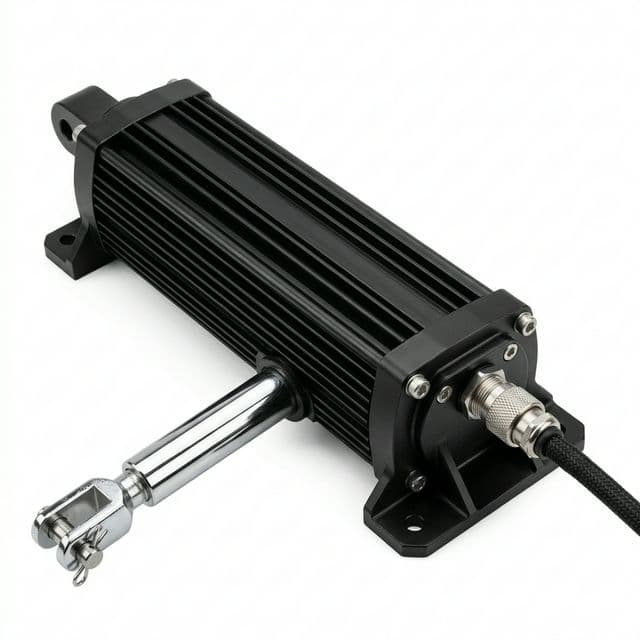
Visual reference: industrial actuator hardware; confirm its operating rating with the manufacturer.
Tool interpretation
What the checker calculates—and what it cannot confirm
The result reports cycle arithmetic and the next vendor checks. The report below explains how published actuator ratings define the actual operating boundary.
Nominal duty
The checker divides on-time by total cycle length and reports the off-time left in each cycle.
100% boundary included
Equal on-time and cycle-length values are accepted as a 100% powered requirement with no off-time.
Evidence-driven
Later sections compare the request with official vendor ratings and show the conditions each source publishes.
The checker calculates on-time divided by total cycle length, then estimates powered hours from the daily schedule and that ratio.
Load, ambient temperature, and motion profile are included as RFQ context only; they do not change the calculated ratio.
Check the complete actuator rating at the required load, stroke, speed, ambient temperature, starts per hour, and installation conditions.
Compare electric and hydraulic options only after both are sized against the same duty profile and uptime target.
Report summary
Core conclusions and decision signals
These blocks answer the buyer question first, then make the operating boundary explicit so the page does not over-promise.
| Term | What it means | How to use it |
|---|---|---|
| Continuous duty | The actuator or motor is intended for sustained operation until thermal equilibrium is reached inside its rated envelope. | Use when you are writing the broad requirement or searching for a product class. |
| 100 percent duty cycle | A rating that signals uninterrupted operation is possible in a defined operating zone, not automatically at worst-case load and temperature. | Use in RFQs only when you also provide load, speed, ambient temperature, and cycle profile. |
| Full-load duty cycle | The published duty limit at the manufacturer's stated maximum dynamic load and reference temperature. | Use to avoid over-reading a headline 100% claim. |
| Thermal duty curve | The load-speed-temperature operating envelope that shows where continuous operation is allowed. | Use for final selection and supplier validation before release. |
Common low-duty reference
10%
LINAK LA23 shows 2 minutes on and 18 minutes off.
Industrial DC example
20%
LINAK LA36 allows up to 20% through 600 mm stroke at a 40 C ambient reference.
Full-load smart actuator example
50%
Thomson’s 2026 brochure and manual say 50% at full load and 25 C; its online product page still says 45%. Confirm the controlled revision.
Hydraulic-class electric option
445 kN
The RSX family is designed for 100% duty and reaches 100,000 lbf across its models; that does not establish 100% duty at maximum force.
Proof map
What the public record confirms and what it still cannot confirm
This stage1b layer maps each core conclusion to reviewed official material and marks the places where the public record is still too thin for a clean procurement decision.
| Conclusion | What the reviewed sources show | Primary sources | Updated |
|---|---|---|---|
| The reviewed official documents frame continuous service as a thermal-envelope question, not as a standalone public test standard called "100 percent duty cycle linear actuator." | ABB defines S1 by thermal equilibrium, Thomson uses continuous and intermittent duty zones, and Tolomatic uses RMS thrust and velocity limits. | ABB motor guideThomson PC Series brochureTolomatic IMA manual | 2026-10-02 |
| Headline 100% duty claims still need load and temperature conditions. | Thomson Electrak XD states that all models are rated to 45% duty at full load and 25 C, with higher duty possible only at lower load or lower ambient temperature. | Thomson Electrak XD brochure | 2026-10-02 |
| Commodity electric actuators remain intermittent in public catalogs. | LINAK LA23 publishes 10% duty, while LA36 publishes 20%, 15%, and 10% bands depending on stroke and lists full performance only from +5 C to +40 C. | LINAK LA23 data sheetLINAK LA36 data sheet | 2026-10-02 |
| Life-test numbers and continuous-duty proof are different documents. | LINAK describes B10 as a statistical life estimate derived from product test-cycle data and lists environmental variables the calculator excludes. | LINAK actuator-life article | 2026-10-02 |
| Industrial continuous-duty platforms still depend on RMS and thermal limits. | Thomson only allows 100% duty inside the continuous zone, while Tolomatic defines its IMA continuous region using RMS thrust and velocity. | Thomson PC Series brochureTolomatic IMA manual | 2026-10-02 |
| Gap | Current public state | Why limited | Minimum next step |
|---|---|---|---|
| Cross-vendor 100% duty test basis for full actuator assemblies | The official documents reviewed on 2026-10-02 describe vendor-specific operating envelopes rather than one cross-vendor pass/fail test. | Public material points back to vendor-specific load, speed, stroke, ambient, and RMS envelopes rather than one universal pass-fail method. | Ask for the exact duty-test basis in writing: dynamic load, stroke, speed, ambient, orientation, dwell, and allowable winding temperature. |
| Comparable public pricing for continuous-duty industrial actuators | The official product material reviewed here does not provide a comparable cross-brand configured price benchmark. | Most industrial continuous-duty pages reviewed are quote-led, and total cost depends on motor, drive, feedback, sealing, and force package. | Compare total installed cost, downtime risk, controls integration, and maintenance interval in the RFQ instead of list price alone. |
| Application-specific life at your exact duty profile | Public life estimates do not by themselves confirm duty-cycle capability for a specific load, speed, and environment. | Life depends on RMS thrust and speed, temperature, stroke, contamination, and mounting details that brochures do not fully publish. | Request an application-specific life estimate or thermal validation before release. |
| Hot enclosure or washdown derating | Official sources publish ambient ranges and some IP options, but no universal derating rule for every sealed cabinet or washdown install was found. | Self-heating, enclosure airflow, sealing, and cleaning regime are application-specific and often missing from catalog summaries. | Treat sealed cabinets, direct sun, or washdown as separate validation items even when the actuator headline says 100% duty. |
Method and evidence
How the screening method works
The checker calculates on-time divided by cycle length and estimates powered hours from the daily schedule. Load, temperature, and motion stay as supplier-review context; no generic stress multiplier is applied.
Cycle math
On-time divided by total cycle time.
Application context
Carry load, speed, temperature, and motion into supplier review.
Envelope check
Compare the requirement with the selected actuator rating.
| Adjusted-duty band | Likely fit | Action | Why |
|---|---|---|---|
| 100% powered time | The complete actuator assembly must be rated for continuous operation at the required load and speed. | Request the continuous operating envelope, thermal limits, and life basis for the exact configuration. | A 100% arithmetic result leaves no scheduled off-time; the motor label alone does not rate the screw, brake, bearings, seals, or controller. |
| Intermittent powered time | The duty ratio describes the requested on/off pattern, not product suitability. | Compare the required duty ratio with the published rating at your load, stroke, speed, and ambient temperature. | Published duty limits vary by model and operating conditions; there is no universal percentage that proves fit. |
| Frequent starts, reversals, or long daily schedules | Simple on-time arithmetic does not capture acceleration, braking, dwell, or RMS load. | Include starts per hour, motion sequence, daily schedule, and dwell behavior in the sizing request. | These details can change motor and actuator heating without changing the basic on-time ratio. |
| High force, hot ambient, side load, or sealed enclosure | Treat these as configuration-specific thermal and mechanical checks. | Ask the supplier to evaluate the exact force, environment, mounting, and cooling conditions. | No generic duty multiplier can replace the manufacturer’s operating envelope for the selected actuator. |
The checker is not a thermal simulation. It will understate risk if you ignore side load, acceleration peaks, enclosure temperature rise, or supply-voltage sag.
That is why the result always points you back to full-load duty ratings, operating envelopes, and supplier support.
Thomson explicitly distinguishes continuous-operation zones from intermittent zones. LINAK explicitly changes duty ratio by stroke, load, and ambient temperature. Those two patterns explain why a simple keyword match is never enough.
Evidence layer
Source-backed signals from official manufacturer documents
Each row answers a specific claim using official manufacturer material checked on 2026-10-02. The sources show operating conditions, not just headline duty claims.
| Source | Signal | Key data | Decision use |
|---|---|---|---|
| ABB motor guide | S1 continuous running duty | Defines continuous running duty as constant load long enough to reach thermal equilibrium, and notes that continuous duty is assumed when motor duty type is not otherwise indicated. | Continuous duty is fundamentally a thermal concept. The whole actuator still needs its own operating envelope. |
| LINAK LA23 data sheet | 10% duty cycle | 2 minutes continuous use followed by 18 minutes not in use. | A useful baseline for what many compact DC actuators still look like when they are not designed for continuous service. |
| LINAK LA36 data sheet | 10% to 20% duty cycle | At 40 C ambient, the data sheet lists 20% through 600 mm stroke, 15% for 601-999 mm, and 10% for 1000-1200 mm. It also gives different operating-temperature limits by condition. | Stroke length and temperature can reduce usable duty even inside the same actuator family. |
| Thomson Electrak XD brochure | Up to 100% duty; published full-load values differ by document | The 2026 brochure and February 2026 installation manual state 50% at full load and 25 C. The online product page and older XD brochure state 45%; confirm the controlled rating for the exact configuration. | A headline 100% statement is not blanket approval, and even current manufacturer documents should be reconciled by model and revision. |
| Thomson PC Series precision actuators | Continuous-operation zone | The brochure defines a continuous-operation zone where 100% duty is allowed and an intermittent zone controlled by RMS load. | Continuous duty should be read from the operating envelope, not assumed from a product label alone. |
| LINAK actuator-life article | B10 lifetime estimate | LINAK describes B10 as a statistical lifetime estimate built from product test-cycle data and notes that changing temperature, humidity, and vibration are not included in the calculation. | A life estimate is not a duty-cycle rating; request the test basis and operating envelope separately. |
| Tolomatic electric rod actuators | 100% duty cycle and 24 x 7 reliability | Tolomatic positions its electric rod actuator families as 100% duty-cycle platforms for high-duty applications. | True continuous-duty electric options do exist, but they sit in a more industrial class than low-cost brushed actuators. |
| Tolomatic IMA manual | Continuous region defined by RMS thrust and velocity | Defines the continuous region using RMS thrust and velocity, and says significant side loading is outside the actuator’s intended use. | Industrial continuous-duty platforms still require application math and thermal discipline. |
| Tolomatic RSX catalog | 100% duty-cycle hydraulic-class actuator | The RSX catalog describes the family as designed for 100% duty and offers models up to 100,000 lbf (445 kN), but it does not establish that maximum thrust and 100% duty apply to the same configuration. | At the high-force end, continuous-duty electric actuators are usually premium, application-engineered products. |
- Defines S1 continuous running duty as operation at constant load until thermal equilibrium is reached.
- Notes that continuous running duty is assumed for motor operation if duty type is not otherwise indicated.
- Publishes a 10% duty cycle reference: 2 minutes on and 18 minutes off.
- Useful as a baseline for compact DC actuator expectations.
- Shows 20%, 15%, and 10% duty windows depending on stroke length.
- States full performance from +5 C to +40 C, with reduced performance outside that zone.
- Markets duty cycle up to 100%, but also states 45% at full load and 25 C.
- Explains that lower load or lower ambient temperature can raise usable duty.
- Lists duty cycle up to 100% depending on load, but shows 45% full-load duty at 25 C for the displayed models.
- That figure differs from the 50% full-load rating in Thomson’s 2026 Smart Actuation brochure and February 2026 installation manual.
- Its Electrak XD specification table lists 50% full-load duty at 25 C.
- Use this alongside the installation manual, and reconcile it with the 45% value on the online product page before specifying a model.
- Section 8.2 plots maximum permissible duty against dynamic load at a 25 C reference temperature; its full-load point is 50%.
- This differs from the 45% value on the online product page and older XD brochure, so request the controlled rating for the purchased configuration.
- Defines a continuous-operation zone where 100% duty cycle is allowed.
- Uses RMS load logic for intermittent operation outside that zone.
- Defines B10 as a statistical life estimate for use within product specifications and describes the actuator test-cycle data behind it.
- Notes that humidity, changing temperatures, and momentary vibrations are not included in the calculator.
- Positions the portfolio as 100% duty cycle capable.
- Calls out 24 x 7 reliability for high-duty applications and highlights IP69K options for harsh washdown work.
- Defines the continuous region using RMS thrust and velocity, with an example of operation under force for 100% of the time with no dwells.
- States the actuator is intended for guided and supported loads, not significant side loading.
- Describes the RSX family as designed for 100% duty cycle, with models up to 100,000 lbf (445 kN); the catalog does not establish both at one maximum-force configuration.
- Shows an oil-cooled option for extended high-duty and high-force performance; confirm the selected model and operating envelope.
Compare and choose
Which path matches your duty profile
A single answer is rarely correct for every process. Use the mode switch and the comparison table to decide whether you are still shopping a low-duty DC actuator or stepping into a different product class.
- Ask for the operating envelope at your actual load, stroke, and ambient temperature.
- Keep the duty rating and life estimate separate; ask for the test profile and limits behind each claim.
- Brushless motors, ball screws, and roller screws are common signals of the right product class.
- Request confirmation of thermal monitoring, overload protection, and life assumptions.
| Option | Typical duty window | Force and control | Watchouts | Best for |
|---|---|---|---|---|
| Commodity 12 V or 24 V DC actuator | 10% to 20% in the LINAK LA23 and LA36 examples shown here | Good for simple extend-retract motion at moderate force | Thermal cooldown is mandatory, and stroke length plus ambient temperature can reduce usable duty further | Hatches, access panels, and low-frequency positioning |
| Continuous-duty electric rod actuator | Up to 100% when operated inside the rated envelope | Precise and clean with better motion control | Higher upfront cost, quote-led sizing, and duty claims that still depend on thermal or RMS limits | Packaging, industrial automation, and high-uptime machinery |
| Hydraulic-class electric actuator | Continuous service for high-force applications | Strong force density with electric positioning benefits | Large, expensive, and highly application-specific | Replacing hydraulic cylinders in cleaner or smarter systems |
| Hydraulic cylinder | Very strong for harsh high-force cycles | Excellent force capability, less clean and less simple | Leaks, maintenance burden, and infrastructure cost | Severe-duty force applications with shock loading |
Nominal powered time is 75%, with 15 seconds off per cycle.
Compare the 75% requirement with the supplier rating at the actual load, stroke, speed, and ambient conditions.
Nominal powered time is 4.2%, or about 5 minutes of powered time in a 2-hour schedule.
A low ratio is not a fit approval; also validate ingress protection, current draw, and the published duty window.
Nominal powered time is 53.3%, with 7 seconds off per cycle and about 5.3 powered hours in a 10-hour schedule.
Request a supplier review that includes starts per hour, process speed, and the complete duty envelope.
A duty percentage cannot be calculated until run time and total cycle length are known.
Record the motion cycle, then compare hydraulic-class electric and hydraulic options at the required force and environment.
Risks and limits
Failure modes that matter before release
This section exists to prevent the page from becoming a hype sheet. The goal is to make the cost, reliability, and scenario-fit trade-offs explicit.
| Risk | Impact | Warning sign | Mitigation |
|---|---|---|---|
| Treating 100% duty as unconditional | Overheating, nuisance trips, or shortened life | Supplier quote omits load, speed, or ambient assumptions | Request the duty curve or full-load duty rating in writing. |
| Ignoring ambient temperature | Safe duty margin collapses in enclosed or hot environments | Application sits near ovens, outdoors in summer, or inside sealed cabinets | Apply a temperature derating and verify with the vendor. |
| Sizing only from static load | Motor current and thermal load exceed expectation during motion | Acceleration, side load, or friction is not quantified | Use dynamic load, stroke, speed, and cycle data in the RFQ. |
| Missing process-level uptime needs | Catalog fit looks fine but plant uptime still suffers | Daily run hours and maintenance windows are undefined | Screen both per-cycle duty and total active hours per day. |
| Reading motor-duty language as whole-actuator proof | The screw, brake, bearings, seals, or controller becomes the weak link | The quote references S1 or continuous motor duty but omits the actuator assembly envelope | Validate the complete actuator operating envelope, not only the motor label. |
| Using published life numbers as a 100% duty guarantee | Expected life is overstated and maintenance windows slip | Cycle-life or B10 values are quoted without duty-cycle or temperature test basis | Ask how the life number was generated and whether the same duty profile applies to your job. |
Dynamic load and peak load
Stroke length and speed target
Ambient temperature and enclosure condition
Mounting orientation, side load, and guide arrangement
Daily active hours and maintenance window
Whether motion is reciprocating, holding, or one-way
A published full-load duty ratio or continuous-duty curve
Reference ambient temperature for the rating
Whether the rating applies to the full actuator assembly
Thermal protection behavior or monitoring notes
Life assumptions for the target motion profile
Test basis for any published B10 or cycle-life number
FAQ
Questions that come up in sourcing and design reviews
Search the list below if you need to defend a specification choice, explain the alias merge, or brief a buyer who only saw the words 100 percent duty cycle.
If the duty review starts from a 1000 lb 110v linear actuator request or a 110v ac linear actuator search, or a 12 inch linear actuator current draw screening request, or a 12 linear actuator 12v alias query, or a 12 volt actuator timer control request, or a 12 volt linear actuator high speed high-speed screening request, screen the electrical sizing question first, then bring the real starts-per-hour profile back into this continuous-duty page.
Request sizing supportRe-run the checker