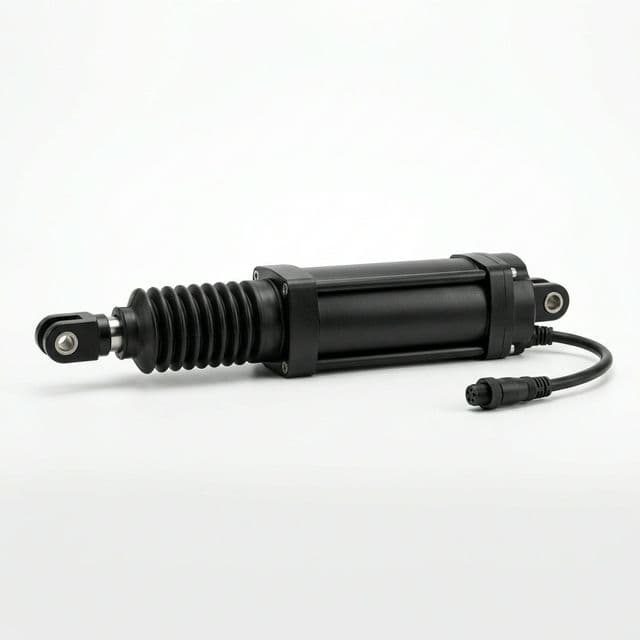
Linear Actuator Market Update (2026-W19): HTSUS Technical Corrections and RFQ Controls for Section 232 Exposure
Week 19 brief for custom linear actuator buyers: HTSUS technical corrections, Section 232 RFQ controls, and immediate OEM actions before PO release decisions.
One-line decision (Week 19): do not reset actuator IP/duty targets this week; immediately update RFQs, broker instructions, and quote controls to reflect FR Doc 2026-08297 (published 2026-04-29) technical corrections under the Section 232 full-value framework.
Research window: 2026-04-05 to 2026-05-05 (last 30 days).
Audience: OEM engineers, sourcing managers, actuator buyers, and automation teams across U.S., EU, and global industrial programs.
For custom linear actuators, this week's pressure is declaration execution quality, not a new IP-class redesign mandate.
Applies to: U.S.-bound imports, EU/U.K.-linked programs with metal-content exposure, and global OEM/distributor actuator sourcing teams sharing RFQ templates.
Not in scope: legal advice, SKU-level binding tariff rulings, or any claim of a new mandatory actuator IP-rule release in this research window.
Last verified: 2026-05-05.
Start here: OEM Linear Actuator RFQ Checklist, IP54 vs IP67 vs IP69K Linear Actuator Selection, Week 18 Update, Week 17 Update, and Contact the engineering team.
Why This Week Matters
- The strongest new signal in this window is not a new actuator hardware standard, but a tariff-operational correction that changes how some actuator assemblies should be declared and reviewed.
- For custom linear actuators, procurement mistakes can now create bigger losses than design mistakes in the short term.
- Teams that still treat Section 232 as a single-rate simplification risk quote rework, margin leakage, and avoidable delivery slips.
Research Method (3 Rounds, Strict Scope)
| Round | Scope | Verification result | Publish relevance |
|---|---|---|---|
| Round 1 | Actuator regulation / certification / safety / reliability | No new actuator-specific mandatory IP-rule or safety-rule release was verified in this window. IEC 60529 public lifecycle remains edition 2.0 with stability date 2027; EU machinery harmonised standards page still points to prior listed amendments (latest listed amendment in that page set is March 2026); OSHA notice reviewed here concerns NRTL scope expansion process, not a new actuator product rule. | Sets boundary: do not manufacture a “new IP mandate” narrative. |
| Round 2 | Sourcing / lead-time / OEM buyer impact | Strong buyer signal verified: FR Doc 2026-08297 (2026-04-29) issues two technical corrections to Annex IV under Proclamation 11021 and adds HTSUS heading 9903.82.01 for Note 16-listed products that do not contain aluminum/steel/copper. | Direct impact on RFQ fields, customs-declaration hygiene, and landed-cost control for mixed-material actuator assemblies. |
| Round 3 | Verify only Round 1-2 candidates | Re-checked candidate documents only: FR 2026-08297, FR 2026-06960, FR 2026-07229, FR 2026-07303, FR 2026-08559, IEC 60529 page, EC Machinery page, OSHA NRTL notice. No lateral expansion to broad automation headlines. | Evidence is strong enough for a buyer-facing W19 update. |
What Changed (Last 30 Days)
| Date | Primary source | What changed | Why actuator buyers should care now |
|---|---|---|---|
| 2026-04-29 (published), effective 2026-04-06 | Federal Register FR Doc 2026-08297 | BIS issued two technical corrections and one clarification for Proclamation 11021 implementation. | This is a direct execution-level change for customs data and RFQ assumptions, especially for mixed-material actuator assemblies. |
| 2026-04-29 | FR Doc 2026-08297 | New HTSUS heading 9903.82.01 added for Note 16-listed goods that do not contain aluminum/steel/copper, and therefore are not subject to those duties. | Programs importing actuator kits with non-metal-heavy line items need cleaner part-level declaration logic to avoid over- or under-charging duty. |
| 2026-04-29 | FR Doc 2026-08297 | Note 16(e) inconsistency corrected by removing an extra paragraph to align intended coverage for heading 9903.82.06. | Reduces ambiguity in filing interpretation; teams should align broker instructions and internal tariff playbooks now. |
| 2026-04-09 (published), effective 2026-04-06 | Federal Register FR Doc 2026-06960 (Proclamation 11021) | Section 232 duties for covered metal goods apply on full customs value, with published 50% / 25% / 10% structures by clause and condition. | RFQs that still use legacy metal-content shorthand can produce unreliable quote economics. |
| 2026-04-14 | Federal Register FR Doc 2026-07229 (A-570-967) | Preliminary AD review results for aluminum extrusions from China; 18 firms treated as part of China-wide entity when separate-rate eligibility not shown; 79 firms rescinded in part. | Origin/supplier mapping quality remains a cost-control requirement for extrusion-dependent actuator programs. |
| 2026-04-15 | Federal Register FR Doc 2026-07303 (C-570-968) | Preliminary CVD review results with 164.29% rates for six non-responsive exporters/producers using adverse facts available. | High-stress scenario pricing remains necessary before MOQ or annual-award commitment. |
| 2026-05-04 | Federal Register FR Doc 2026-08559 | Annual opportunity notice lists A-570-967 and C-570-968 for May-cycle review requests (deadline by end of May 2026 for interested parties). | Not a direct rate change by itself, but it signals that review-process cadence remains active; quote validity windows should stay short. |
What Did Not Change (Boundary Checks)
| Candidate topic | Verified status in this research window | Buyer interpretation |
|---|---|---|
| New mandatory actuator IP rating release | Not verified. IEC 60529 public page continues to show edition 2.0 with stability date 2027. | Keep target IP class based on application conditions, not rumor-driven redesign. |
| New EU machinery harmonised standard shock specific to actuator enclosure/IP in this window | Not verified in the reviewed EC page set; no April/May 2026 machinery harmonised update line was identified there. | Maintain compliance baseline and monitor, but do not claim a fresh mandatory IP reset this week. |
| OSHA actuator product-rule rewrite | Not verified. Reviewed OSHA Federal Register notice concerns NRTL recognition scope process. | Treat as certification ecosystem signal, not an immediate design-spec trigger. |
Which Actuator Types and Applications Are Most Affected
| Actuator type / program | Exposure channel | Decision impact | Immediate buyer action |
|---|---|---|---|
| Custom electric actuators with aluminum extrusion-dependent bodies | Section 232 full-value logic + AD/CVD uncertainty | Quote variance and post-award repricing risk | Add producer/exporter/origin + scenario price lines in RFQ |
| Integrated actuator kits (actuator + bracket + controller + harness) | Mixed-material filing ambiguity under corrected Note 16 logic | Misdeclaration risk on non-metal-dominant sub-lines | Split quote and declaration by line-item metal relevance |
| Outdoor IP67/IP69K actuator families | Cost pressure may trigger supplier substitutions | Reliability drift without explicit notice | Add no-silent-substitution clause and retest trigger |
| High duty-cycle industrial actuators | Thermal and duty behavior can shift with motor/driver source swaps | Field reliability and warranty disputes | Link duty-cycle claims to BOM revision controls |
| EU/U.K.-linked industrial projects using steel subcomponents | Country/process-condition dependent reduced-rate logic and clarifications | Wrong assumptions around rate eligibility | Require written origin-process attestations from suppliers |
| Distributor private-label actuator SKUs | Opaque sub-tier sourcing and declaration practice | Margin erosion from hidden duty pass-through | Add compliance-complete gate before firm quote release |
Cost, Lead-Time, Reliability, and Spec Impact
| Dimension | Evidence-backed impact | Remaining uncertainty | Decision now |
|---|---|---|---|
| Cost | Full-value duty logic and technical corrections can alter declared-duty outcomes for mixed-material assemblies. | Exact burden depends on SKU-level classification and supplier declarations. | Run base/adverse scenarios per line item before final quote acceptance. |
| Lead time | Declaration corrections and broker revalidation can introduce rework loops near PO release. | Response speed differs by importer, broker, and supplier stack. | Add customs-data completeness gate before award. |
| Reliability | Commercial pressure can push undocumented material/controller substitutions. | Supplier disclosure quality is inconsistent. | Enforce source-change retest matrix (IP, duty, thermal). |
| Spec fit | No verified new mandatory actuator IP rule this week; spec drift risk is substitution-driven. | Field-test equivalence across revised BOMs may be weak. | Keep application IP targets; tighten evidence requirements. |
| Warranty | Disputes increase when commercial terms and approved BOM diverge. | Clause quality and document control vary by contract. | Bind warranty to approved BOM + validation record IDs. |
RFQ Fields and Clauses to Add This Week
| Field / clause | Why it matters now | Minimum evidence |
|---|---|---|
| HTS/HS code per quote line | Needed for correct duty path and correction applicability | Broker-reviewed code map |
| Producer legal entity | Supports AD/CVD exposure mapping | Signed supplier declaration |
| Exporter legal entity | Prevents generic-country assumptions | Export docs reference |
| Country of extrusion / melt-pour / smelt-cast (as relevant) | Supports country/process condition checks | Process-route statement |
| Customs value basis | Required for full-value duty modeling | Incoterm + valuation basis letter |
| Metal-content relevance tag by line item | Needed to avoid applying metal duty logic to non-metal lines | BOM-level line classification |
| Scenario split pricing (base / adverse) | Makes award decision robust against review volatility | Two-line quote format |
| Substitution disclosure clause | Controls hidden material/controller changes | ECO/deviation protocol |
| Revalidation trigger matrix | Links sourcing changes to reliability controls | Agreed IP/duty/thermal retest matrix |
| Warranty tied to BOM revision | Strengthens claim enforceability | Warranty annex with revision ID |
Need a rapid award-readiness pass? Run the OEM Linear Actuator RFQ Checklist and escalate edge cases through contact engineering before PO release.
Who Should Act Now (Action Checklist)
| Role | Action | Deadline | Deliverable |
|---|---|---|---|
| Sourcing manager | Reissue RFQ template with corrected tariff-data fields | Within 3 business days | RFQ v2 + supplier acknowledgment |
| Trade compliance lead | Re-map active actuator SKUs for Note 16/Chapter 99 declaration consistency | This week | SKU declaration matrix |
| OEM engineer | Freeze controller/feedback interface revision during current quote cycle | This sprint | Interface lock appendix |
| Quality & reliability lead | Activate substitution-triggered retest workflow | Before pilot gate | Retest SOP |
| Program manager | Add repricing and evidence clauses to commercial terms | Before PO release | Contract addendum |
| Distributor ops | Block firm quote release on missing compliance fields | Immediate | Quote gate checklist |
Risks and Limits
| Risk / boundary | Why it matters | Mitigation |
|---|---|---|
| Technical corrections are execution-focused, not a full policy rewrite | Teams may over-interpret and redesign product specs unnecessarily | Keep engineering scope stable unless application conditions changed |
| Duty outcomes are still SKU- and declaration-dependent | Family-level assumptions can fail at line-item level | Enforce line-level customs data ownership |
| Preliminary AD/CVD outcomes are not final outcomes | Overconfidence can bias long-term contracts | Keep scenario-based pricing until final review cycle outputs publish |
| No new verified actuator-specific mandatory IP/safety release in-window | False urgency can trigger cost-heavy redesign | Use standards watchlist discipline with dated evidence |
| Tool/search ingestion can miss context if used alone | Summary snippets can be misread as final facts | Always anchor decisions in primary documents and effective dates |
Related Execution Links
- OEM Linear Actuator RFQ Checklist
- IP54 vs IP67 vs IP69K Linear Actuator Selection
- Week 18 Update
- Week 17 Update
- Week 16 Update
- Contact the engineering team
FAQ
1) What is the key new Week 19 signal?
The key new signal is FR Doc 2026-08297 (published April 29, 2026), which issues technical corrections and clarification for Proclamation 11021 implementation.
2) Did the U.S. introduce a new Section 232 framework this week?
No. The core framework came with Proclamation 11021 (published April 9, 2026, effective April 6, 2026). Week 19 adds important technical corrections to execution details.
3) Should actuator teams change IP54/IP67/IP69K targets immediately?
No new mandatory actuator IP-rule release was verified in this window. Keep IP targets application-driven and focus on evidence controls.
4) Why does heading 9903.82.01 matter to actuator buyers?
It affects how certain Note 16-listed products that do not contain aluminum/steel/copper should be declared, which can affect duty treatment and quote confidence.
5) Are AD/CVD rates final for all extrusion-related suppliers now?
No. The cited April documents are preliminary review outcomes and process steps; final outcomes remain subject to review procedures.
6) Does FR 2026-08559 itself change actuator duty rates today?
Not directly. It is a process notice for review requests, but it confirms that review-cycle timing remains active and should be reflected in quote validity planning.
7) What is the most common avoidable buyer mistake this week?
Treating the tariff regime as a single flat rule and skipping line-item declaration controls for mixed-material actuator kits.
8) What should teams implement before the next PO round?
A compliance-complete RFQ template: line-item HTS mapping, origin/process declarations, scenario pricing, substitution disclosure, and retest triggers.
Sources
-
Notice of Technical Corrections to the Harmonized Tariff Schedule of the United States for Duties Imposed by Presidential Proclamation 11021 (FR Doc 2026-08297)
Organization: U.S. Department of Commerce, Bureau of Industry and Security (Federal Register)
Date: Published 2026-04-29 (effective date text references 2026-04-06)
URL: https://www.federalregister.gov/documents/2026/04/29/2026-08297/notice-of-technical-corrections-to-the-harmonized-tariff-schedule-of-the-united-states-for-duties-imposed-by-presidential-proclamation-11021 -
FR-2026-04-29 Official PDF (2026-08297)
Organization: GovInfo
Date: 2026-04-29 issue
URL: https://www.govinfo.gov/content/pkg/FR-2026-04-29/pdf/2026-08297.pdf -
Strengthening Actions Taken To Adjust Imports of Aluminum, Steel, and Copper Into the United States (FR Doc 2026-06960, Proclamation 11021)
Organization: Executive Office of the President (Federal Register)
Date: Published 2026-04-09 (effective clauses from 2026-04-06)
URL: https://www.federalregister.gov/documents/2026/04/09/2026-06960/strengthening-actions-taken-to-adjust-imports-of-aluminum-steel-and-copper-into-the-united-states -
FR-2026-04-09 Official PDF (2026-06960)
Organization: GovInfo
Date: 2026-04-09 issue
URL: https://www.govinfo.gov/content/pkg/FR-2026-04-09/pdf/2026-06960.pdf -
Aluminum Extrusions From the People's Republic of China: Preliminary Results and Rescission, in Part, of Antidumping Duty Administrative Review; 2024-2025 (FR Doc 2026-07229, A-570-967)
Organization: U.S. Department of Commerce, International Trade Administration (Federal Register)
Date: 2026-04-14
URL: https://www.federalregister.gov/documents/2026/04/14/2026-07229/aluminum-extrusions-from-the-peoples-republic-of-china-preliminary-results-and-rescission-in-part-of -
Aluminum Extrusions From the People's Republic of China: Preliminary Results and Rescission, in Part, of Countervailing Duty Administrative Review; 2024 (FR Doc 2026-07303, C-570-968)
Organization: U.S. Department of Commerce, International Trade Administration (Federal Register)
Date: 2026-04-15
URL: https://www.federalregister.gov/documents/2026/04/15/2026-07303/aluminum-extrusions-from-the-peoples-republic-of-china-preliminary-results-and-rescission-in-part-of -
Antidumping or Countervailing Duty Order, Finding, or Suspended Investigation; Opportunity To Request Administrative Review... (FR Doc 2026-08559)
Organization: U.S. Department of Commerce, International Trade Administration (Federal Register)
Date: 2026-05-04
URL: https://www.federalregister.gov/documents/2026/05/04/2026-08559/antidumping-or-countervailing-duty-order-finding-or-suspended-investigation-opportunity-to-request -
IEC 60529:1989 (public lifecycle metadata page)
Organization: IEC Webstore
Date accessed: 2026-05-05
URL: https://webstore.iec.ch/en/publication/2447 -
Machinery (MD) harmonised standards page
Organization: European Commission
Date accessed: 2026-05-05
URL: https://single-market-economy.ec.europa.eu/single-market/goods/european-standards/harmonised-standards/machinery-md_en -
TÜV SÜD America, Inc.: Application for Expansion of Recognition (FR Doc 2026-07142)
Organization: U.S. Department of Labor, OSHA (Federal Register)
Date: 2026-04-14
URL: https://www.federalregister.gov/documents/2026/04/14/2026-07142/tv-sd-america-inc-application-for-expansion-of-recognition
Bottom line: this week is about declaration quality and sourcing control, not a new actuator IP-rule reset.
Author

More Posts
OEM Linear Actuator RFQ Checklist for Faster Quotes
A practical RFQ checklist that helps OEM teams receive accurate linear actuator quotations faster by defining force, stroke, duty cycle, environment, and validation requirements up front.
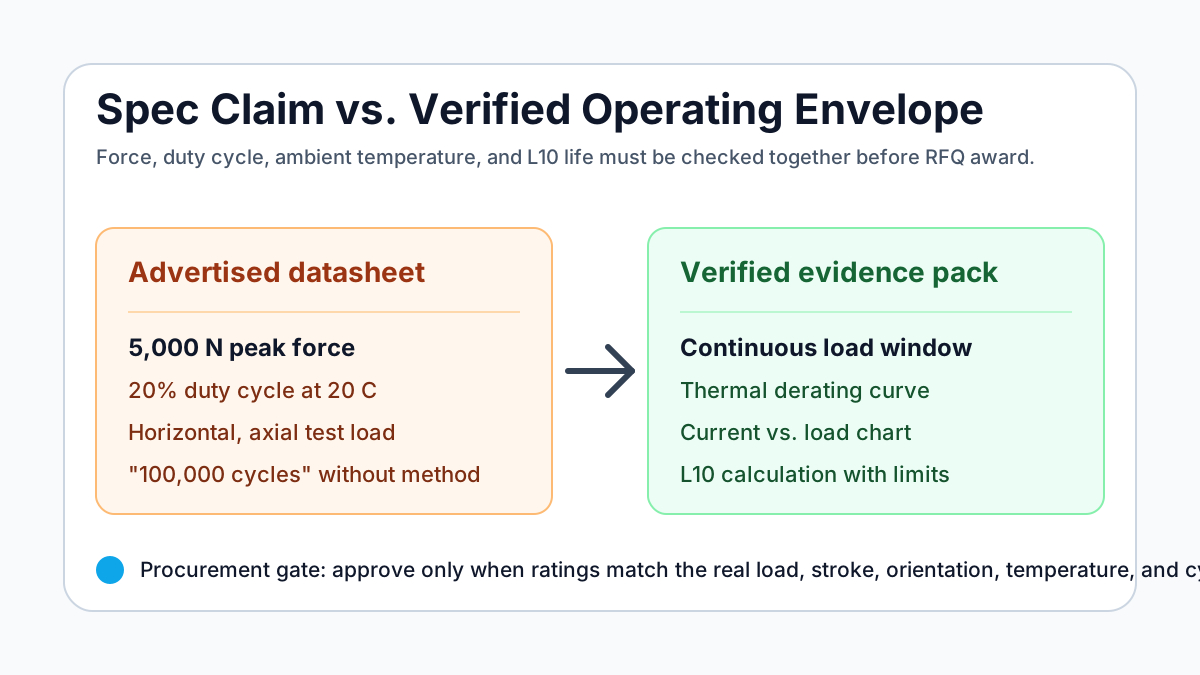
Linear Actuator Spec Inflation: A Procurement Guide to Verifying Force, Duty Cycle, and Lifespan Ratings
Verify linear actuator force, duty cycle, and L10 life claims before RFQ award. Use supplier evidence checks to avoid inflated specs and early failures.
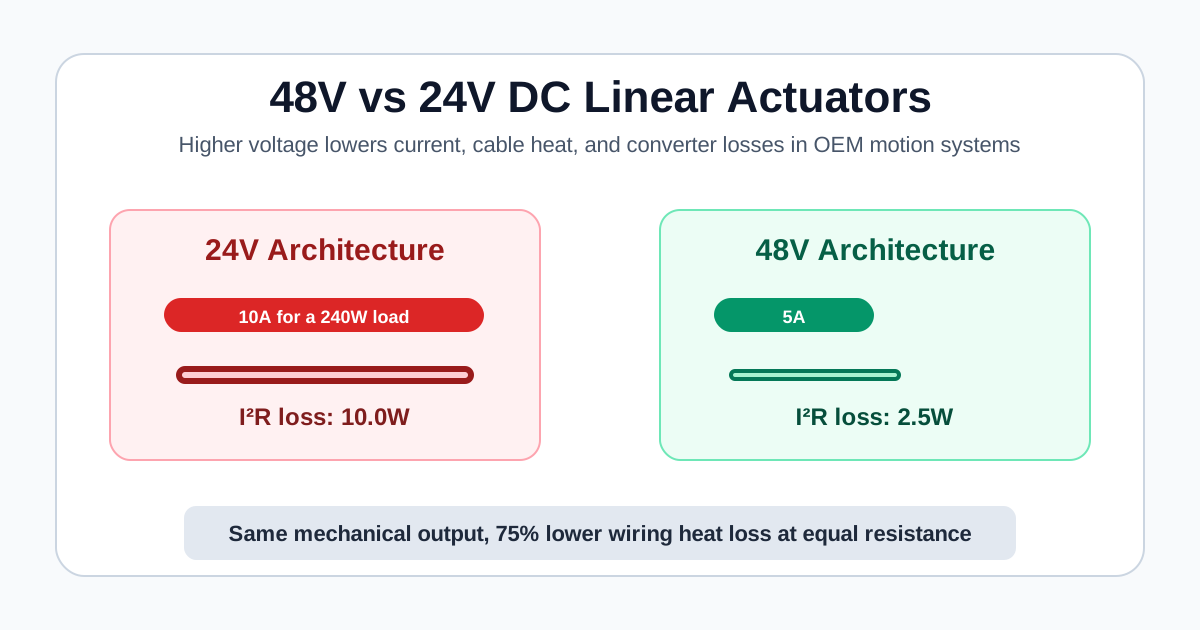
48V vs 24V DC Linear Actuators: Why OEMs Are Shifting to Higher Voltage Architectures
A comprehensive engineering and procurement guide comparing 48V and 24V DC linear actuators. Learn how 48V architectures reduce I²R heat losses, save copper costs, and improve duty cycles in AGVs, AMRs, and industrial automation.