48V vs 24V DC Linear Actuators: Why OEMs Are Shifting to Higher Voltage Architectures
A comprehensive engineering and procurement guide comparing 48V and 24V DC linear actuators. Learn how 48V architectures reduce I²R heat losses, save copper costs, and improve duty cycles in AGVs, AMRs, and industrial automation.
48V vs 24V DC Linear Actuators: Why OEMs Are Shifting to Higher Voltage Architectures
Last Updated: June 24, 2026
Executive Conclusion: For decades, 24V DC has been the gold standard for industrial electromechanical motion. However, as Autonomous Mobile Robots (AMRs), Automated Guided Vehicles (AGVs), and heavy-duty battery-powered machinery evolve, OEMs are aggressively migrating to 48V DC architectures. Shifting to a 48V linear actuator halves the continuous current draw, reduces I²R thermal losses by 75%, and allows procurement teams to drastically cut wiring harness costs—all while remaining under the strict 60V DC Safety Extra Low Voltage (SELV) limit.
This guide is built specifically for procurement teams, mechanical engineers, and electrical system designers who must evaluate the Total Cost of Ownership (TCO) and performance limits of custom linear actuators.
Scope note: the comparison assumes equal mechanical output, similar actuator geometry, and a DC motor winding designed for the target voltage. 48V is most compelling for high-current, battery-powered, or long-cable OEM systems; it is not a blanket replacement for every light-duty 24V actuator.
1. The Physics Driving the 48V Transition
To understand why 48V is rapidly becoming the new standard in mobile and battery-powered automation, we have to look at fundamental electrical engineering principles—specifically, Ohm's Law ($V = I \times R$) and Joule's Law for power dissipation ($P = I^2 \times R$).
When you double the system voltage from 24V to 48V, a DC motor requires exactly half the current (Amperage) to generate the same amount of mechanical power (Watts).
Because heat loss in a cable or a motor winding is proportional to the square of the current ($I^2$), halving the current doesn't just cut the heat generation in half—it reduces the thermal loss by 75%.
This massive reduction in wasted heat transforms the operational capabilities of a linear actuator.
The Thermal Bottleneck in Continuous Operation
One of the most common failure modes for a DC linear actuator is thermal overload. When an actuator is rated for a 25% duty cycle, it means the internal DC motor generates heat faster than the sealed housing can dissipate it. If run continuously, the insulation on the motor windings melts, or the internal electronic components fail.
By switching from a 24V motor winding to a 48V motor winding, the internal current drops dramatically. Less current means less heat generation. Consequently, a 48V actuator can often achieve a much higher duty cycle than its 24V counterpart in the exact same physical housing. For OEMs designing material handling equipment that runs 24/7, this thermal efficiency is not just a nice-to-have; it is a critical operational requirement.
2. Why AGVs and AMRs Demand 48V Linear Actuators
The logistics and warehouse automation sector has been the primary catalyst for the 48V revolution. Automated Guided Vehicles (AGVs) and Autonomous Mobile Robots (AMRs) rely heavily on linear actuators for lifting payloads, steering mechanisms, and load transfer systems.
Aligning with Modern Battery Chemistry
Historically, AGVs utilized bulky 12V or 24V Lead-Acid batteries. Today, modern fleets use Lithium Iron Phosphate (LiFePO4) battery packs, which are highly efficient and commonly arrayed in 48V configurations.
If an OEM uses a 48V battery pack but specifies 24V linear actuators, they must introduce a DC-DC step-down converter into the circuit. This converter adds weight, takes up valuable internal chassis space, adds a point of failure, and typically loses 5-10% of the energy to heat during conversion. Specifying native 48V DC linear actuators allows the motors to run directly off the main battery rail, maximizing the robot's operational range per charge.
The Peak Thrust Advantage
When an AGV initiates a heavy lift, the linear actuator experiences a massive spike in "inrush current." In a 24V system, this sudden demand for high amperage can cause a momentary voltage drop across the entire system (voltage sag). This sag can trigger low-voltage alarms on sensitive sensors, LiDARs, or edge computing modules sharing the same power bus.
A 48V system is significantly stiffer. It handles peak load spikes with much lower current surges, protecting the rest of the AMR's sensitive electronics from brown-out conditions.
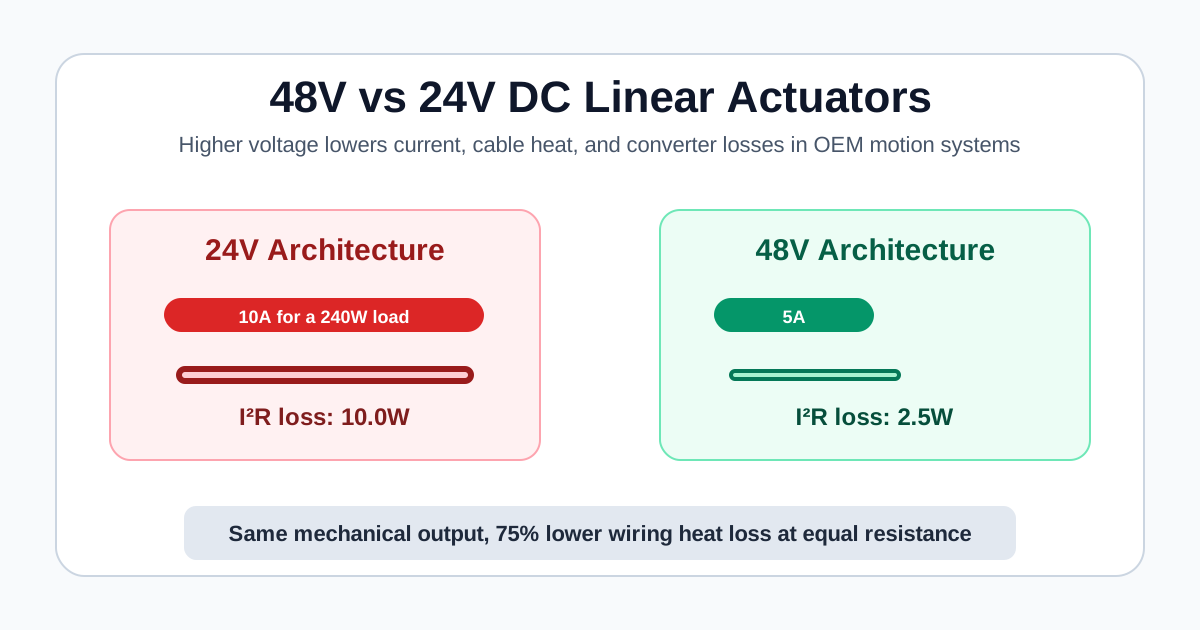
3. Visualizing the I²R Power Loss Advantage
To make this concrete, let's look at the electrical and thermal distribution differences between a 24V and a 48V system attempting to perform the same 240 Watt lifting operation.
As the diagram illustrates, halving the current results in a highly disproportionate drop in wasted heat. This translates directly into cooler motor operation, longer grease life, and extended mean time between failures (MTBF).
4. Engineering & Commercial Comparison: 24V vs 48V
When deciding between a 24V and a 48V custom linear actuator, procurement and engineering must align on the overall machine requirements. Use this structured comparison to guide your decision.
| Decision Matrix Dimension | Legacy 24V DC Actuator | Modern 48V DC Actuator | Business Impact |
|---|---|---|---|
| Current Draw (at equal power) | High (Baseline 100%) | Low (50% of 24V) | 48V allows for smaller, cheaper motor controllers and relays. |
| I²R Thermal Heat Loss | High | 75% Lower | 48V runs significantly cooler, extending the duty cycle and lifespan. |
| Wiring Harness Gauge | Thick (e.g., AWG 12 or 14) | Thin (e.g., AWG 16 or 18) | 48V cuts copper costs dramatically and makes cable routing easier. |
| Voltage Drop Sensitivity | High (Long cables drop voltage easily) | Low (Less affected by resistance) | 48V allows for longer cable runs across large machinery (e.g., solar trackers). |
| Battery Direct Integration | Good for legacy lead-acid machines | Native for modern LiFePO4 packs | 48V eliminates the need for expensive DC-DC step-down converters in AMRs. |
| SELV Safety Compliance | Yes (Under 60V limit) | Yes (Under 60V limit) | Both avoid the strict safety regulations and specialized training required for high-voltage (e.g., 400V) systems. |
| Component Availability | Extremely High (Commodity) | Growing rapidly, but slightly less ubiquitous | 24V is easy to replace off-the-shelf; 48V often implies a higher-end, custom-engineered solution. |
5. Cost Implications for Sourcing and Procurement
If a 48V linear actuator is electrically superior, why do procurement teams still purchase 24V variants? The answer lies in the surrounding component ecosystem and historical supply chains.
The Copper Cost Advantage
Copper prices remain a volatile factor in manufacturing costs. A 48V system requires half the current, which means OEMs can safely step down the American Wire Gauge (AWG) of their wiring harnesses. Replacing hundreds of feet of 12 AWG copper wire with 16 AWG wire across an entire fleet of machines yields massive savings that often overshadow the cost of the actuator itself.
The Controller Ecosystem
Historically, 24V power supplies, relays, and motor controllers were significantly cheaper and more widely available than 48V components. However, this gap is closing rapidly. As the telecom industry, e-bike sector, and electric vehicle markets standardize on 48V infrastructure, the economies of scale have brought 48V servo drives and controllers down to price parity with 24V systems.
Procurement teams should view the 48V transition not as an actuator-level cost increase, but as a system-level cost reduction. You spend slightly more engineering time specifying the 48V motor, but you eliminate DC-DC converters, reduce copper cable thickness, shrink the physical size of motor controllers, and reduce warranty claims related to thermal burnout.
6. Selection Boundaries: When to Stick with 24V
Despite the advantages of 48V, it is not always the correct engineering choice. OEMs should maintain 24V architectures under the following specific conditions:
- Legacy Machine Retrofits: If you are designing a drop-in replacement actuator for an existing agricultural machine or hospital bed that natively outputs 24V, introducing a 48V actuator will require a step-up converter, defeating the efficiency gains.
- Light-Duty, Low-Force Applications: If the actuator only requires 1 or 2 Amps at 24V to open a small ventilation flap, the thermal losses are negligible. Upgrading to 48V offers no tangible ROI.
- Severe Supply Chain Constraints: If the OEM's global service network relies entirely on stocking 24V commodity replacement parts, breaking that standardization for a minor efficiency gain may disrupt field maintenance.
7. OEM Procurement & Engineering Checklist
Before submitting an RFQ (Request for Quote) for your next custom linear actuator, run through this checklist with your engineering team to determine if a 48V architecture is justified:
- Power Source Verification: Does the machine run on a modern 48V battery pack (e.g., LiFePO4)? If yes, defaulting to 48V actuators eliminates converter inefficiencies.
- Duty Cycle Demands: Does the application require continuous operation (high duty cycle) where thermal buildup is the primary failure risk?
- Cable Length Assessment: Are the actuators located far from the main power supply (e.g., large solar tracking arrays)? 48V mitigates the risk of voltage drop over long cable runs.
- Weight and Space Restrictions: Does the machine require strict weight reduction? 48V allows for thinner wire harnesses and smaller motor drivers.
- Controller Compatibility: Have we verified that our chosen PLCs, edge controllers, or servo drives are natively rated for 48V output?
- Safety Compliance: Have we confirmed local regulations accept 48V under the SELV (Safety Extra Low Voltage) standard for the target market?
8. Frequently Asked Questions (FAQ)
Q: Does a 48V linear actuator push harder or faster than a 24V actuator? A: Not inherently. A well-designed 24V actuator and a 48V actuator can deliver the exact same force and speed (mechanical power). The difference is that the 48V actuator does it while consuming half the amperage, generating far less internal heat, and putting less stress on the wiring.
Q: Is 48V safe for human-collaborative robots? A: Yes. Under standard electrical safety guidelines (such as IEC 60364), Direct Current voltages under 60V DC are classified as Safety Extra Low Voltage (SELV). They do not present a severe shock hazard and generally do not require heavy shielding, grounding, or specialized high-voltage technician certifications to service.
Q: Can I run a 24V actuator on a 48V power supply? A: No. Applying 48V to an actuator wound and rated for 24V will cause the motor to spin at twice its rated speed, draw excessive current, and likely burn out the windings or destroy the gearbox within seconds. Always match the motor winding to the supply voltage.
Q: Will a 48V linear actuator cost more? A: The actuator itself usually costs exactly the same to manufacture. The difference lies entirely in how the copper coils inside the DC motor are wound (thinner wire, more turns for 48V). The true cost impact is felt in the surrounding system (controllers, cables, batteries).
9. Next Steps for OEM Designers
The transition to 48V is inevitable for high-performance, battery-powered automation. The benefits in thermal management, wire harness cost reduction, and direct battery integration provide a decisive competitive advantage for OEMs building next-generation AGVs and heavy machinery.
If your current linear actuators are suffering from thermal overload, or if your AGV design team is looking to maximize battery life without sacrificing lifting force, it is time to evaluate custom 48V solutions.
Ready to upgrade your system architecture? Our engineering team specializes in custom-wound 48V linear actuators designed specifically for heavy-duty OEM applications.
Contact us today to request a custom 48V actuator quote or to discuss your specific load, speed, and duty cycle requirements.
10. Sources and References
This guide synthesizes engineering principles and industry trends from leading authorities on electromechanical motion:
- Oriental Motor: Brushless DC Motors (BLDC Motors) - Features for AGV / AMR Drivetrain Applications (Details the shift from 24V to 48V in AMR drivetrains to maintain battery voltage stability).
- ServoLinearActuator: Choosing the Right Voltage for Your Linear Actuator (Discusses the efficiency of 36V/48V systems in applications with long cable runs and solar power).
- TiMOTION: Electric Actuator Solutions for Automatic Guided Vehicle (AGV) and Autonomous Mobile Robot (AMR) (Highlights the integration of high-reliability linear actuators in custom AGV platforms).
- Cincon Electronics: AGV & AMR Power Solutions (Details the standard usage of 48V battery architectures in modern warehouse lifting AGVs).
Author

Categories
More Posts
Linear Actuator Market Update (2026-W17): Mexico Aluminum Import Notice, U.S. Full-Value 232, and Sourcing Controls
Week 17 brief for custom linear actuator buyers: Mexico aluminum notice and U.S. full-value 232 updates, plus RFQ and sourcing controls to apply before PO release.
Linear Actuator Market Update (2026-W27): Proclamation 11032 Shifts Section 232 Tariff Thresholds and RFQ Sourcing Strategies
Week 27 brief for custom linear actuator buyers: Proclamation 11032 lowers the U.S.-origin metal threshold to 85%; update RFQs and HTS evidence before award.
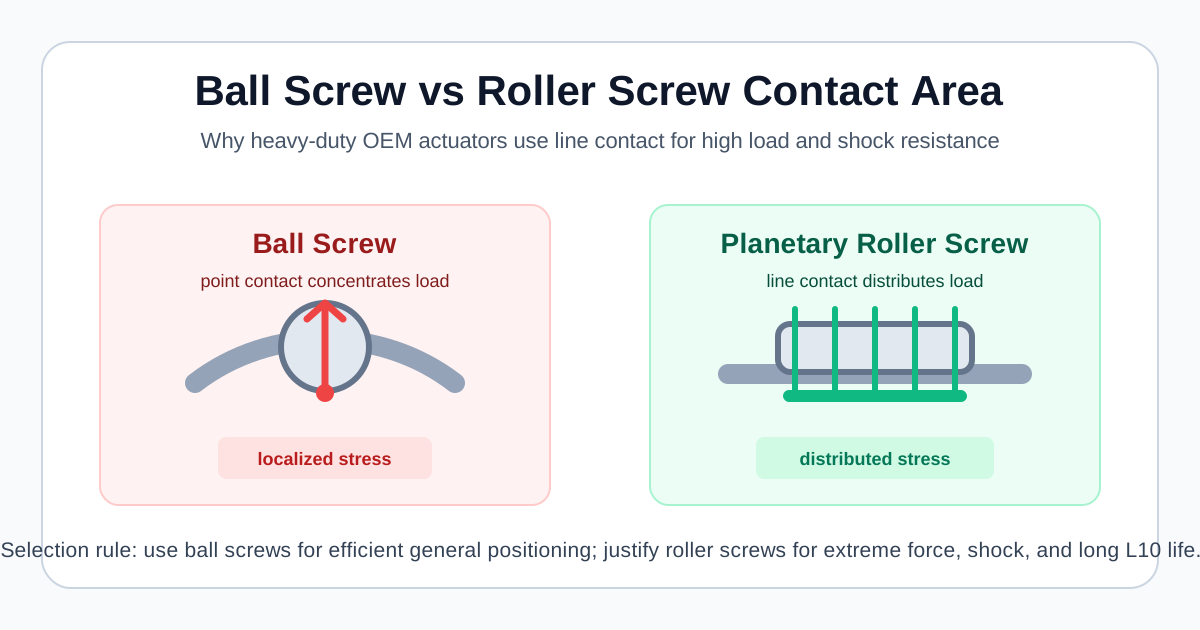
Ball Screw vs. Planetary Roller Screw Linear Actuators: A Heavy-Duty OEM Sourcing Guide
Compare ball screw vs roller screw linear actuators for heavy-duty OEM sourcing. Review load, life, cost, duty cycle, and RFQ inputs before you request a quote.