Replacing Hydraulic Cylinders with Heavy-Duty Electric Actuators: The 2026 OEM Guide to TCO and ESG
Compare hydraulic cylinders with custom electric linear actuators for 2026 OEM TCO, ESG, sizing trade-offs, and RFQ inputs before a conversion project.
Replacing Hydraulic Cylinders with Heavy-Duty Electric Actuators: The 2026 OEM Guide to TCO and ESG
Last Updated: July 21, 2026
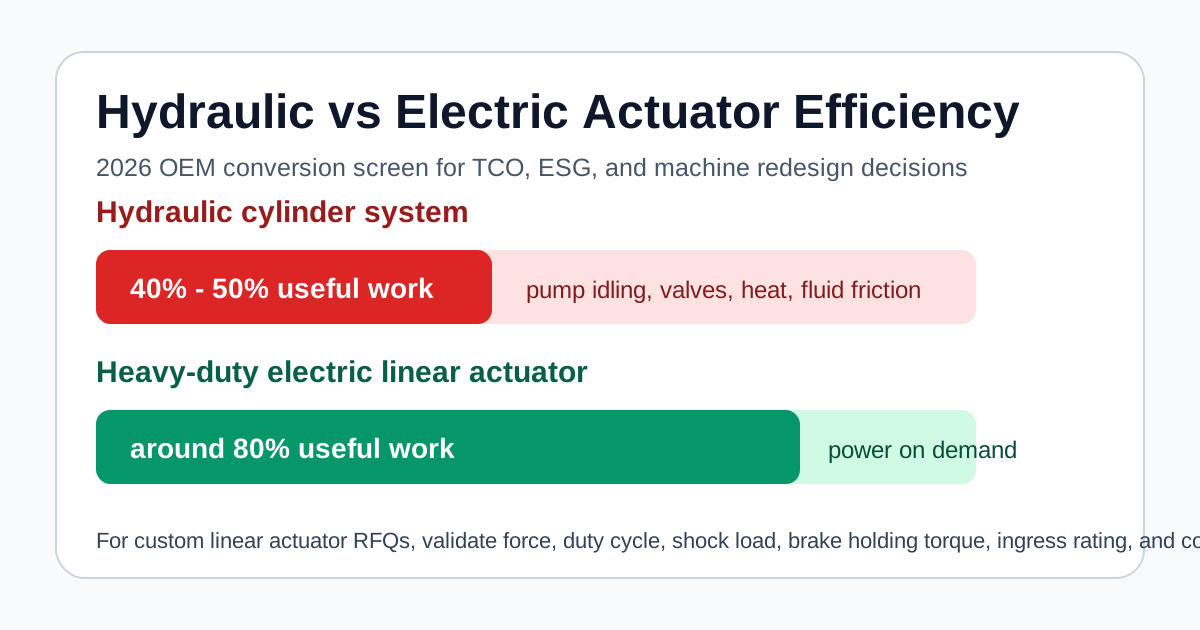
Executive Conclusion: For decades, hydraulic cylinders were the default choice for heavy-duty lifting, pressing, and material handling. However, driven by stringent Environmental, Social, and Governance (ESG) standards, rising maintenance labor costs, and the demand for extreme precision, OEMs are rapidly migrating to heavy-duty electric linear actuators. While electric systems often carry a higher initial procurement cost, they can lower Total Cost of Ownership (TCO) by moving from typical hydraulic system efficiency around 40% - 50% to roughly 80% in well-sized electric architectures, removing hydraulic-fluid leak paths, and reducing routine fluid, filter, hose, and seal maintenance.
This guide is designed for procurement managers, mechanical engineers, and sustainability officers tasked with evaluating the transition from fluid power to electromechanical motion in 2026. Use it before RFQ when deciding whether a custom linear actuator can replace a hydraulic cylinder in a new machine platform or redesign.
Scope note: This is a global OEM procurement and engineering screen, not a final safety or legal compliance sign-off. Validate the final architecture against regional machine safety, electrical, EMC, ingress, washdown, and hazardous-waste obligations. Hydraulics can still be appropriate for severe shock, very high force density, dirty remote service, or applications where the hydraulic power unit already serves multiple axes efficiently.
1. The 2026 Tipping Point: Why OEMs Are Abandoning Hydraulics
Historically, electric linear actuators could not compete with the extreme force density of hydraulic cylinders. If you needed to move 10,000 lbs (45,000 N), hydraulics were often the default shortlist.
Today, that barrier is much narrower. Modern heavy-duty electric actuators utilizing precision ball screws or roller screws paired with high-torque brushless DC (BLDC) motors or AC servomotors can be configured for high-force industrial duties. For projects above roughly 10,000 lbf, request screw life, column buckling, brake holding torque, gearbox thermal, and side-load calculations rather than accepting catalog thrust alone. With force parity achievable in many OEM machines, the conversation shifts to efficiency, maintenance, controllability, and environmental impact.
The Problem with the Hydraulic Power Unit (HPU)
A hydraulic system is never just a cylinder. It requires a sprawling infrastructure: a central Hydraulic Power Unit (HPU) with an electric motor constantly driving a pump, massive oil reservoirs, complex valve manifolds, accumulators, and miles of high-pressure hosing.
Electric actuators, by contrast, are decentralized. The mechanical screw, gearbox, and motor are packaged into a single clean cylinder. You simply run electrical cables to the unit, completely freeing up machine chassis space and eliminating point-of-failure plumbing.
2. System Efficiency and Power Consumption
The most immediate operational difference between hydraulic and electric actuation is how they consume energy.
Hydraulic systems are fundamentally inefficient. The central pump must run continuously to maintain system pressure, even when the cylinder is completely stationary. Energy is lost constantly through fluid friction, pressure drops across valves, and pump inefficiencies.
Electric linear actuators offer power-on-demand. When the actuator is holding a position or not moving, the motor is powered off. Mechanical brakes or self-locking lead screws hold the load with zero energy consumption.
3. Total Cost of Ownership (TCO) Analysis
When sourcing components, buyers often experience "sticker shock" when comparing a bare hydraulic cylinder against a complete electric actuator. However, comparing component-to-component ignores the massive infrastructure required to run hydraulics.
The following matrix compares the lifecycle realities of both technologies.
| Feature / Metric | Hydraulic Cylinder System | Heavy-Duty Electric Actuator | Business Impact for OEMs |
|---|---|---|---|
| System Energy Efficiency | 40% - 50% (Constant pump operation) | 80% - 85% (Power on demand) | Vastly lower operational electricity costs for the end-user. |
| Maintenance Requirements | High (Fluid changes, filter replacement, seal leaks) | Low (Grease-for-life, no fluid management) | Drastic reduction in maintenance labor and downtime. |
| Environmental & ESG Risk | High (Oil leaks, hazardous waste, fire hazard) | Zero (Clean operation, no toxic fluids) | Easier compliance with ESG standards (ISO 14001) and safe for food/medical processing. |
| Position & Force Control | Moderate (Requires complex proportional valves) | Extremely High (Servo/encoder precision) | Enhanced manufacturing yield, repeatability, and immediate data logging. |
| Infrastructure Footprint | Large (Requires HPU, reservoirs, hoses, valves) | Compact (Just the actuator and local controller) | Saves valuable machine chassis space; reduces overall machine weight. |
| Temperature Sensitivity | High (Viscosity changes in extreme cold/heat limit performance) | Low (Consistent performance across wide temp ranges) | Reliable operation outdoors or in harsh industrial environments. |
| Lifecycle TCO (10 Years) | High (Driven by ongoing maintenance, downtime, and energy) | Low (Higher upfront, but massive long-term OPEX savings) | Higher Return on Investment (ROI) and easier value-based selling to end-users. |
4. ESG Compliance and the Cost of a Leak
Environmental, Social, and Governance (ESG) criteria are no longer optional "feel-good" metrics; they are hard requirements for winning bids in the EU and North America.
A single hydraulic hose burst or a degrading seal creates a hazardous oil spill. For industries like food and beverage packaging, pharmaceuticals, agriculture, or semiconductor manufacturing, a hydraulic fluid leak doesn't just mean a messy floor—it means ruined product batches, severe regulatory fines, and facility downtime for hazardous waste cleanup.
By converting to fluid-free electric actuators, OEMs instantly eliminate the environmental risk of oil spills. This clean, silent operation allows end-users to confidently deploy machinery in sensitive environments while boosting their own corporate ESG scores.
5. Hydraulic to Electric Conversion Checklist
If your engineering team is evaluating replacing a legacy hydraulic system with modern electric linear actuators, use this checklist to ensure a successful transition:
- Legacy Cylinder Baseline: Have we documented bore, rod diameter, stroke, mounting centers, cushion style, port layout, and measured working pressure instead of relying on nominal cylinder size?
- Force and Speed Calculation: Have we calculated the peak thrust (N or lbs) and continuous speed (mm/s) to ensure the electric actuator's screw/motor combination can match the hydraulic output?
- Duty Cycle Evaluation: Does the application require holding a heavy load statically? (Electric actuators with internal brakes or self-locking lead screws excel at zero-energy holding).
- Environmental Ingress (IP Rating): Will the actuator be exposed to outdoor elements or high-pressure washdowns? (Specify IP67 or IP69K to protect internal electronics).
- Control Integration: Can our current PLC communicate directly with the electric motor controller via modern fieldbuses like CAN bus, Modbus, or IO-Link?
- Space Constraints & Routing: Have we mapped how eliminating the massive Hydraulic Power Unit (HPU) will allow us to redesign and slim down the machine chassis?
- Shock and Side-Load Protection: Does the axis see impact, overhung load, or misalignment that requires guides, dampers, trunnion mounts, or a larger screw diameter?
- ESG Reporting Targets: Have we quantified the environmental benefit of eliminating hydraulic oil, so our sales team can market this as a "Green/Fluid-Free" machine?
For related sizing work, pair this conversion checklist with our industrial linear actuator selection guide, heavy-duty 12V linear actuator guide, linear actuator current draw guide, and 12V linear actuator controller guide.
6. Frequently Asked Questions (FAQ)
Q: Can an electric actuator withstand shock loads like a hydraulic cylinder? A: Hydraulic fluid is naturally compressible, which allows hydraulic cylinders to absorb shock loads well. Electric actuators are mechanically rigid (metal-on-metal). If your application involves severe shock impacts (e.g., a rock crusher), you must specify shock-absorbing mounts, internal elastomer dampeners, or purposefully over-size the ball screw to prevent mechanical fracture.
Q: Are electric actuators slower than hydraulics? A: Not necessarily. While hydraulics are excellent at moving huge masses quickly when paired with a massive pump, modern electric actuators driven by servo motors and high-lead ball screws can achieve speeds exceeding 1,000 mm/s. The key is specifying the right motor RPM and screw pitch.
Q: What happens if there is a power failure while holding a load? A: If an electric actuator uses an ACME lead screw (which is inherently self-locking), the load will stay safely in place without power. If it uses a high-efficiency ball screw (which can backdrive), an electromagnetic brake must be installed on the motor. The brake defaults to "locked" when power is cut, safely holding the load.
Q: Is the upfront cost significantly higher? A: Yes, the bare electric actuator and its drive controller typically cost more than a bare hydraulic cylinder. However, once you factor in the cost of the hydraulic pump, reservoir, valves, hoses, assembly labor, and the lifetime cost of energy and maintenance, the electric system consistently wins the TCO calculation.
Q: When should an OEM keep hydraulics instead of converting to electric? A: Keep hydraulics on the shortlist when the machine needs extreme shock absorption, very high short-duration force from a shared HPU, simple field repair in remote dirty sites, or when the existing hydraulic infrastructure already powers several synchronized axes. Electric conversion is strongest when precision, cleanliness, energy use, data logging, and maintenance reduction drive the business case.
7. Ready to Eliminate Hydraulics from Your Machinery?
The transition to electrification is the most impactful upgrade an OEM can make in 2026. Replacing hydraulics with heavy-duty electric linear actuators instantly modernizes your machine, slashes energy consumption, and eliminates messy fluid maintenance for your end-users.
Our application engineers specialize in fluid-to-electric conversions, helping you match the exact force, speed, and dimensional requirements of legacy hydraulic cylinders with high-performance electromechanical solutions.
Contact our engineering team today to request a custom specification review and RFQ for your heavy-duty applications.
8. Sources and References
- Curtiss-Wright: Hydraulic-to-Electric actuation resource
- Tolomatic: Electric Linear Motion for Hydraulic Replacement eBook
- ISO: ISO 14001:2015 Environmental management systems
- European Commission: Corporate sustainability reporting
Author

Categories
More Posts
Linear Actuator Market Update (2026-W16): Full-Value Tariff Rules and RFQ Controls for IP/Duty/Interface Risk
Decision-level update for actuator buyers: what changed in the last 30 days, where evidence is strong vs limited, and what OEM teams should change in RFQs before the next PO cycle.
Linear Actuator Market Update (2026-W15): Tariff Windows, EU Machinery Amendment, and RFQ Controls
Decision-level weekly brief for actuator buyers: verified U.S./EU signals in the last 30 days, what changed, what did not verify, and what OEM teams should change in RFQs now.
IP54 vs IP67 vs IP69K Linear Actuators for OEM Applications
A practical comparison of IP54, IP67, and IP69K actuator protection levels, including where each rating works, where it fails, and how OEM teams should choose.