Ball Screw vs. Planetary Roller Screw Linear Actuators: A Heavy-Duty OEM Sourcing Guide
Compare ball screw vs roller screw linear actuators for heavy-duty OEM sourcing. Review load, life, cost, duty cycle, and RFQ inputs before you request a quote.
Ball Screw vs. Planetary Roller Screw Linear Actuators: A Heavy-Duty OEM Sourcing Guide
Last Updated: July 19, 2026
Executive Conclusion: When specifying a custom linear actuator, the choice of drive mechanism dictates the actuator's lifespan, load capacity, and footprint. While ball screws remain the highly efficient, cost-effective standard for general automation, planetary roller screws are increasingly dominating the heavy-duty sector. By utilizing line contact instead of point contact, roller screws deliver up to 15 times the lifespan and can handle massive shock loads, making them the ultimate electromechanical replacement for legacy hydraulic cylinders.
This guide is designed for procurement teams, mechanical engineers, and system integrators who must balance upfront capital expenditure (CapEx) against Total Cost of Ownership (TCO) in continuous-duty applications.
Scope and limits: This guide focuses on global OEM sourcing for screw-driven electromechanical actuators. It does not replace supplier sizing software, bearing life calculations, machine guarding review, or safety certification review. Before issuing a purchase order, validate axial load, stroke, speed, duty cycle, shock factor, side load, mounting orientation, ingress protection, and ambient temperature.
RFQ shortcut: If your team already knows the load, stroke, speed, and duty-cycle target, start with the OEM Linear Actuator RFQ Checklist or send the specifications for engineering review.
1. The Physics of Force Transfer: Point vs. Line Contact
The fundamental difference between these two technologies lies in how the mechanical load is transferred from the screw shaft to the nut.
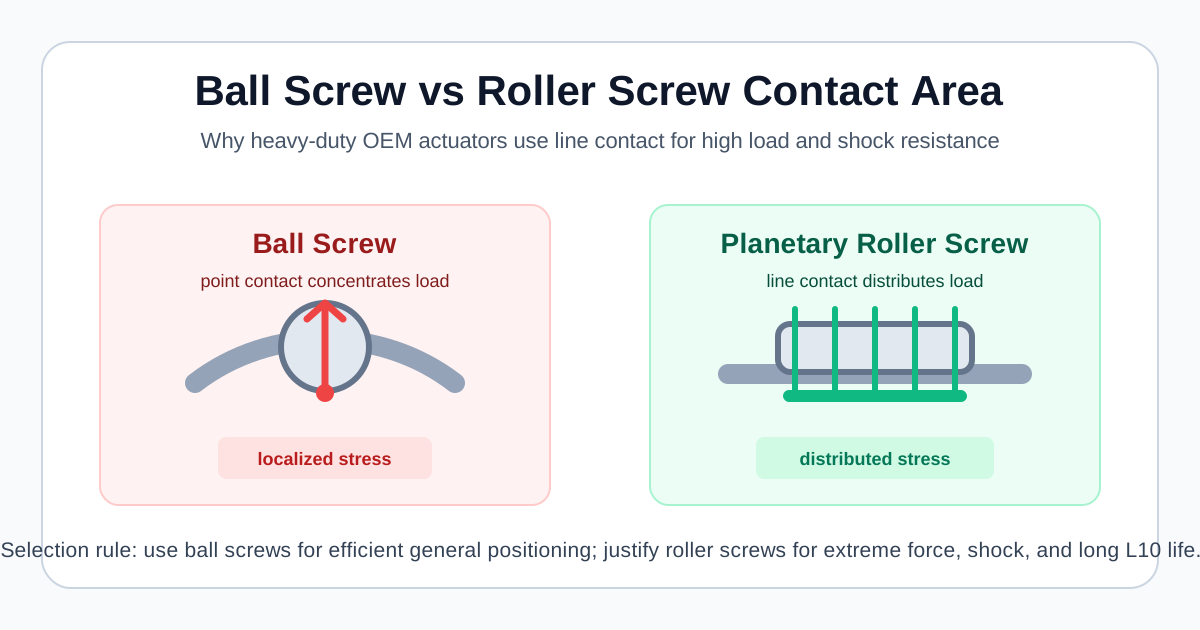
The Ball Screw: Point Contact
A ball screw utilizes recirculating steel balls riding in the threaded grooves between the screw shaft and the nut. Because they are spheres, they make point contact with the threads.
- Advantage: Extremely low friction (often >90% efficient), minimal heat generation, and excellent high-speed capabilities.
- Limitation: Under extreme loads (e.g., stamping, riveting, or injection molding), all the force is concentrated on tiny points. This causes high localized stress, leading to material fatigue, "brinelling" (micro-indentations), and eventual mechanical failure.
The Planetary Roller Screw: Line Contact
A roller screw replaces the recirculating balls with a planetary arrangement of threaded rollers that orbit the main screw shaft. These cylindrical rollers match the thread profile perfectly, creating line contact.
- Advantage: The load is distributed over a surface area that is drastically larger. This allows the actuator to handle extreme shock loads and massive continuous forces in a very compact package.
- Limitation: The sliding friction of the rollers makes them slightly less efficient (typically 80-85%) and inherently more expensive to manufacture due to tight machining tolerances.
2. Visualizing the Load Distribution
3. Engineering & Sourcing Comparison Matrix
When determining the optimal linear actuator for your machine, evaluate the following parameters.
| Evaluation Metric | Ball Screw Actuator | Planetary Roller Screw Actuator | OEM Business Impact |
|---|---|---|---|
| Initial Cost (CapEx) | Moderate (Highly commoditized) | High (Precision machining required) | Ball screws are easier to fit into initial machine budgets. |
| Dynamic Load Capacity | Moderate (Up to ~5-10 tons) | Extremely High (15+ tons common) | Roller screws can replace heavy hydraulic cylinders in compact spaces. |
| Expected Lifespan (L10) | Standard | Up to 15x longer than ball screws | Roller screws drastically reduce Total Cost of Ownership (TCO) in 24/7 applications. |
| Shock Load Resistance | Poor (Balls can dent the tracks) | Excellent | Roller screws survive presses, stamping, and riveting applications. |
| Efficiency / Heat | > 90% (Low heat generation) | ~ 80-85% (More sliding friction) | Ball screws are better for extremely high-speed, continuous back-and-forth motion with low loads. |
| Maintenance | Regular lubrication required | Less frequent, handles abuse better | Roller screws lower machine downtime and field service costs. |
| Best-Fit Applications | Packaging adjustments, light presses, automation axes, general positioning | Pressing, riveting, injection molding, mobile machinery, hydraulic replacement | Match the screw type to the real failure mode, not only the catalog thrust rating. |
4. Replacing Hydraulic Cylinders: The TCO Argument
For decades, applications requiring massive force (like metal forming, injection molding, or heavy material handling) relied entirely on hydraulic cylinders.
However, OEMs are actively shifting to electromechanical actuators to eliminate fluid leaks, reduce noise, and remove the need for bulky HPU (Hydraulic Power Unit) systems.
While a ball screw actuator might physically fit the space of a hydraulic cylinder, it rarely survives the shock loads. The roller screw is the only electromechanical technology capable of matching the power density and shock resistance of fluid power. While the initial purchase price of a roller screw actuator is higher than a hydraulic cylinder, the TCO is lower when factoring in the elimination of hydraulic fluid maintenance, increased energy efficiency, and precise programmable positioning.
Before converting a hydraulic axis, also validate the continuous-duty actuator requirement, the control-voltage architecture using the 48V vs 24V DC actuator guide, and the enclosure target using the IP54 vs IP67 vs IP69K actuator selection guide.
5. OEM Procurement Checklist: Specifying the Right Technology
Before issuing an RFQ for a custom linear actuator, use this checklist to align your engineering and purchasing requirements:
- Define the Force Profile: Does the application require pushing more than 10,000 lbs (45 kN) continuously? (If yes, lean toward Roller Screw).
- Analyze Shock Loads: Will the actuator hit a hard stop, perform pressing/riveting, or experience sudden jarring loads? (If yes, specify Roller Screw).
- Calculate the Duty Cycle: Is the actuator running continuously with rapid directional changes where heat buildup is a concern but loads are moderate? (If yes, specify Ball Screw).
- Review the Footprint: Are you trying to cram 15 tons of force into a very narrow envelope where a massive ball screw won't fit? (If yes, specify Roller Screw).
- Evaluate the Budget: Can the project absorb a higher upfront CapEx to achieve a 10x reduction in field replacement costs? (If yes, specify Roller Screw).
6. Frequently Asked Questions (FAQ)
Q: Are planetary roller screws the same as Acme (lead) screws? A: No. Acme screws (or lead screws) rely entirely on sliding friction, making them cheap but highly inefficient (often under 40%) and prone to rapid wear. Roller screws use precision-threaded orbiting rollers, offering high efficiency and extreme load capacities.
Q: Can a ball screw handle continuous duty? A: Yes, but only if properly sized. If a ball screw is operating near its maximum dynamic load rating, continuous duty will cause it to fail prematurely. A roller screw of the exact same physical size will easily survive the same continuous load.
Q: Do roller screws require lubrication? A: Yes. Despite their durability, the metal-on-metal sliding friction inside a roller screw means it must be properly lubricated (usually with specialized grease or oil bath, depending on the speed and temperature).
7. Start Your Custom Actuator Project
Selecting between a ball screw and a roller screw shouldn't be a guessing game. It requires a precise calculation of your machine's dynamic loads, L10 life expectations, and operational environment.
Ready to transition away from hydraulics or upgrade an underperforming ball screw? Our engineering team designs custom high-capacity linear actuators tailored precisely to your force and spatial constraints.
Submit your technical specifications for a custom engineering review and RFQ.
Sources & References
Author

Categories
More Posts
Linear Actuator Market Update (2026-W18): U.S. Aluminum Extrusion AD/CVD Review Signals and RFQ Controls
Week 18 brief for custom linear actuator buyers: U.S. aluminum extrusion AD/CVD signals and RFQ controls to limit cost, lead-time, and compliance surprises.
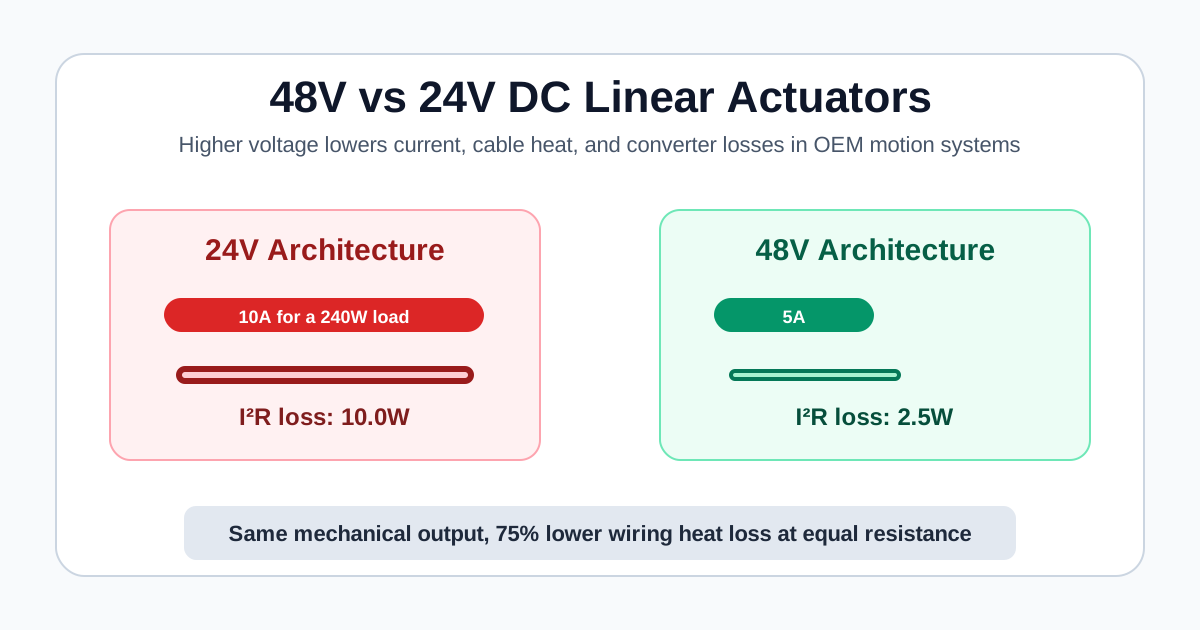
48V vs 24V DC Linear Actuators: Why OEMs Are Shifting to Higher Voltage Architectures
A comprehensive engineering and procurement guide comparing 48V and 24V DC linear actuators. Learn how 48V architectures reduce I²R heat losses, save copper costs, and improve duty cycles in AGVs, AMRs, and industrial automation.
Linear Actuator Market Update (2026-W16): Full-Value Tariff Rules and RFQ Controls for IP/Duty/Interface Risk
Decision-level update for actuator buyers: what changed in the last 30 days, where evidence is strong vs limited, and what OEM teams should change in RFQs before the next PO cycle.