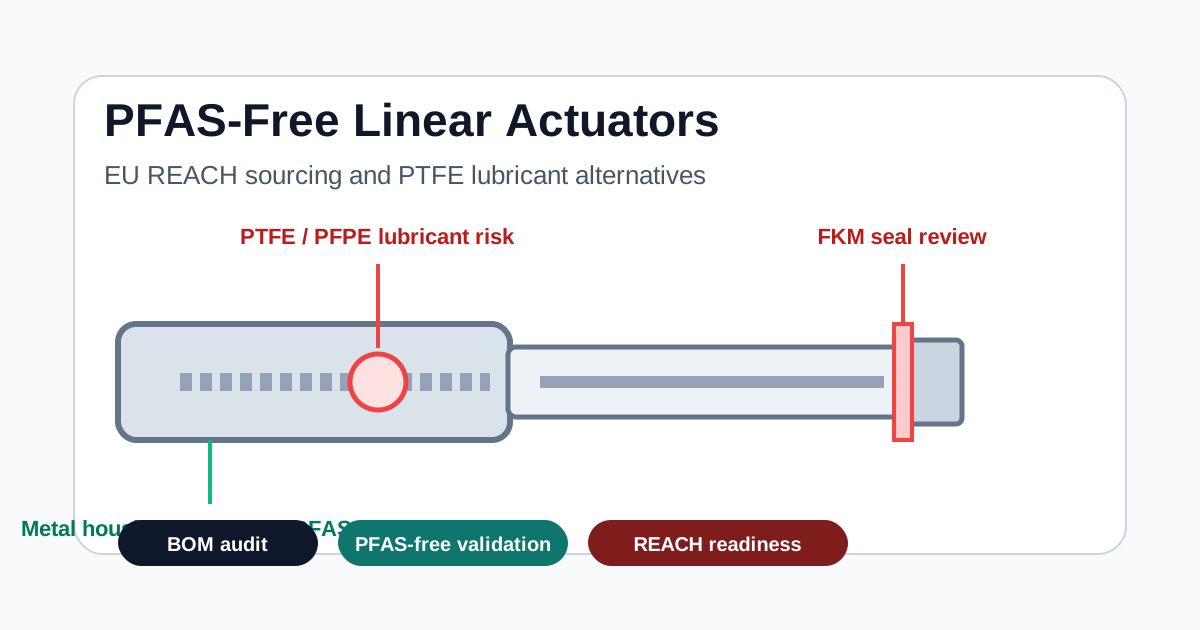
PFAS-Free Linear Actuators: EU REACH Sourcing Guide
Source PFAS-free linear actuators for EU REACH readiness: audit PTFE/PFPE greases, compare seal alternatives, and contact engineering for RFQ review.
PFAS-Free Linear Actuators: Navigating EU REACH Compliance and PTFE Lubricant Alternatives
Last Updated: July 23, 2026
Executive Conclusion: As of this update (July 23, 2026), the broad European Chemicals Agency (ECHA) PFAS restriction remains a REACH restriction process rather than a finished blanket ban. It is still changing OEM sourcing expectations. For linear actuators, the "forever chemicals" problem can hide in plain sight: PTFE (Teflon) greases on the lead screw, PFPE base oils, FKM (Viton) O-rings for harsh sealing, and fluoropolymer coatings. Procurement teams and engineers should start material disclosure and substitute-validation work now. Waiting can create late redesign, customer nonconformance, or restricted-market risk if a final restriction or customer restricted-substance list covers the material; rushing without lifecycle testing can cause higher friction, wear, current draw, or seal failures.
This guide is designed for procurement managers, mechanical engineers, and compliance officers who need to audit their linear actuator supply chain, understand the engineering trade-offs of PFAS-free alternatives, and establish a compliant sourcing strategy.
Fast sourcing path: If you already have actuator SKUs under review, pair this guide with the OEM Linear Actuator RFQ Checklist, IP54 vs IP67 vs IP69K selection guide, and ball screw vs roller screw guide before sending the BOM to contact engineering.
1. Where Are PFAS "Forever Chemicals" Hiding in Your Actuator?
When most OEMs think of linear actuators, they think of aluminum, steel, and copper. However, achieving high efficiency, long cycle life, and high IP ratings (like IP67 or IP69K) often relies on fluoropolymers that can fall under broad PFAS definitions or customer restricted-substance policies.
If your current supplier claims their actuators are "PFAS-free" without providing a detailed Material Declaration, you should be skeptical. Here are the three primary areas where PFAS is embedded in standard electromechanical linear actuators:
A. The Leadscrew / Ballscrew Lubrication (PTFE Greases)
To minimize friction and prevent galling between a steel lead screw and a bronze or plastic nut, manufacturers use high-performance greases. Common risk points include synthetic greases thickened with PTFE (Polytetrafluoroethylene) or base oils using PFPE (Perfluoropolyether). These can provide strong boundary lubrication under heavy loads, but they require explicit material disclosure during PFAS screening.
B. Environmental Sealing (FKM / Viton O-Rings)
Industrial and agricultural actuators operating in harsh environments rely on robust shaft seals and O-rings. FKM (commonly known by the brand name Viton™) is a fluorocarbon elastomer favored for chemical and temperature resistance. Under broad PFAS proposals and many customer restricted-substance lists, fluorinated elastomers should be treated as a declaration and substitution-review item.
C. Internal Coatings and Plastic Nuts
Some specialized actuators use PTFE-coated extension tubes to prevent ice build-up or reduce wiper seal friction. Furthermore, many self-lubricating plastic Acme nuts are molded from POM (Polyoxymethylene) compounded with 15-20% PTFE powder.
2. The Engineering Trade-Offs of PFAS-Free Alternatives
Removing PTFE from linear actuators is not as simple as swapping one bucket of grease for another. PTFE possesses an incredibly low coefficient of friction and does not break down easily under high shear forces.
When replacing PTFE greases and FKM seals, OEMs must navigate several engineering trade-offs. The table below is a sourcing-screening matrix, not a universal approval matrix. Actual approval still depends on the supplier formulation, actuator geometry, load, stroke, speed, temperature, duty cycle, and washdown exposure.
| Component / Metric | Typical PFAS-Risk Incumbent | PFAS-Free Candidate | Engineering Impact / Trade-off |
|---|---|---|---|
| Lubricant Package | PFPE oil and/or PTFE thickener | PAO, ester, calcium sulfonate, or lithium complex grease with no intentionally added PFAS | Run low-temperature start, rated-load current, and screw/nut wear tests; do not approve by SDS wording alone. |
| Boundary Lubrication | Low-friction fluoropolymer film | MoS2, graphite, borate/ester additive chemistry, or improved screw surface finish | Expect less margin in high-load duty cycles; validate controller, fuse, and thermal sizing on worst-case load. |
| Wear Life Evidence | Legacy cycle data based on PTFE/PFPE grease | Side-by-side life test using the same load, stroke, speed, temperature, and duty cycle | Treat supplier life data as SKU-specific. Upsize the screw/nut or derate duty cycle if backlash or current rises early. |
| Dynamic Rod / Wiper Seal | FKM/FPM/Viton fluorocarbon | HNBR, NBR, EPDM, silicone, or TPU depending on fluid and temperature exposure | EPDM is poor with petroleum oils; NBR ages faster under ozone/UV; HNBR is often the safer harsh-duty bridge. |
| Plastic Nut / Wear Strip | POM or PA compounded with PTFE filler | POM, PA, UHMWPE blends, MoS2-filled grades, or lubricated bronze nut | Check noise, backlash growth, moisture swelling, and wear debris sensitivity during endurance testing. |
| Compliance Status | Material may fall under existing restrictions, the broad ECHA PFAS proposal, or customer RSLs | Candidate only after CAS-level declaration and restricted-substance review | Treat "PFAS-free" as a supplier claim until backed by material declaration, test evidence, and change-control terms. |
Decision Rule: A PFAS-free substitution is usually lower risk when the actuator runs below about 70% of rated dynamic load, has moderate duty cycle, and is not exposed to aggressive oils, ozone, UV, or IP69K washdown. Require side-by-side validation, derating, or mechanical upsizing when the application uses sustained high load, low-temperature starts, medical/food restricted-substance rules, or harsh outdoor washdown.
Evidence & Limitation Note: PFAS-free synthetic greases can perform well, but they should not be treated as drop-in equivalents for every lead screw or ball screw design. If the actuator frequently operates near its rated load, the supplier must provide lifecycle test data for the exact grease, screw/nut pair, seal material, and duty cycle.
3. Sourcing Checklist: Qualifying PFAS-Free Actuator Suppliers
To ensure your supply chain remains compliant without compromising machine reliability, procurement and engineering teams should jointly execute this checklist when auditing suppliers:
- BOM Material Audit: Request a full disclosure of all lubricants, seals, and plastic compounds used in the actuator.
- Regulatory Scope Freeze: Record the target markets and rule set: EU REACH proposal/Annex XVII status, customer restricted-substance list, US TSCA reporting exposure, and any state-level procurement rules.
- Grease Validation: Explicitly ask if the factory grease contains PTFE, PFPE, or PFAS. If yes, request a transition timeline to a Lithium Complex, PAO, or Calcium Sulfonate alternative.
- Seal Transition Plan: Verify that all FKM/Viton O-rings and wiper seals are being transitioned to NBR (Nitrile) or HNBR. Ensure the new seals maintain the required IP67/IP69K rating.
- Derating Analysis: Request lifecycle test data (cycle count to failure) comparing the legacy PTFE grease against the proposed PFAS-free grease. Plan to derate the actuator's duty cycle if necessary.
- Formal Declaration: Obtain a signed "Declaration of Conformity for PFAS Restrictions under EU REACH" from the actuator manufacturer.
- Change-Control Clause: Require notification before any lubricant, seal, plastic compound, or coating change after PPAP, FA sample approval, or production release.
Need a supplier evidence template? Start with the OEM actuator RFQ checklist and send the declaration pack to our engineering team for a focused sourcing review.
4. FAQ: Transitioning to PFAS-Free Actuators
Q: Will switching to a PFAS-free grease void our existing IP69K ratings?
A: No. The IP69K rating relates to the mechanical design of the housing and seals (resisting high-pressure water). However, if you also change the seal material (e.g., from FKM to NBR) to achieve PFAS compliance, the manufacturer must re-certify the new seal design against IP69K standards to ensure the new material doesn't deform under high temperature/pressure.
Q: Does compliance mean my actuator will cost more?
A: In the short term, yes. While base materials like NBR and Lithium greases are actually cheaper than FKM and PFPE, the R&D, re-testing, and supply chain separation costs incurred by the manufacturer are typically passed down. Expect a minor premium during the transition period.
Q: If we only sell into the US market, do we need to care about the EU REACH PFAS ban?
A: While EU REACH only legally applies to products sold into the European Economic Area, US regulations (like EPA TSCA reporting rules and various state-level bans, e.g., in Maine and Minnesota) are aggressively targeting PFAS. Transitioning now future-proofs your global supply chain.
Q: Are PTFE greases and FKM seals already banned in every EU actuator application?
A: No. The broad PFAS restriction is still handled through the REACH restriction process, and substance-specific restrictions, exemptions, transition periods, and customer RSLs must be checked for each market and product. Treat PTFE, PFPE, FKM, and other fluorinated materials as disclosure and substitution-review risks rather than assuming one universal ban date.
5. Next Steps for OEM Procurement
Delaying the transition to PFAS-free linear motion puts your European market access at severe risk. Start by mapping the specific actuator SKUs that are mission-critical to your machines.
If you need engineering support evaluating PFAS-free lubrication profiles, calculating revised wear life, or sourcing fully compliant custom actuators, Contact our engineering team today. We offer pre-validated, REACH-compliant custom linear actuators utilizing advanced PTFE-free synthetic lubricants and HNBR sealing technologies.
Sources & References
- European Chemicals Agency (ECHA): Perfluoroalkyl chemicals (PFAS) restriction proposal - Official overview of the proposed PFAS restriction under REACH.
- European Chemicals Agency (ECHA): Registry of restriction intentions: PFAS restriction dossier - Process record for the broad PFAS restriction proposal.
- European Chemicals Agency (ECHA): Substances restricted under REACH - Annex XVII restriction context for EU market access screening.
- US Environmental Protection Agency (EPA): TSCA section 8(a)(7) PFAS reporting and recordkeeping - US reporting context for PFAS-containing articles and supply-chain records.
Author

Categories
More Posts
July 2026 Section 122 Expiration: Linear Actuator Sourcing
Week 28 brief for custom linear actuator buyers: confirm July 24 Section 122 timing, bonded-entry options, RFQ repricing, and limits.
Linear Actuator Market Update (2026-W17): Mexico Aluminum Import Notice, U.S. Full-Value 232, and Sourcing Controls
Week 17 brief for custom linear actuator buyers: Mexico aluminum notice and U.S. full-value 232 updates, plus RFQ and sourcing controls to apply before PO release.
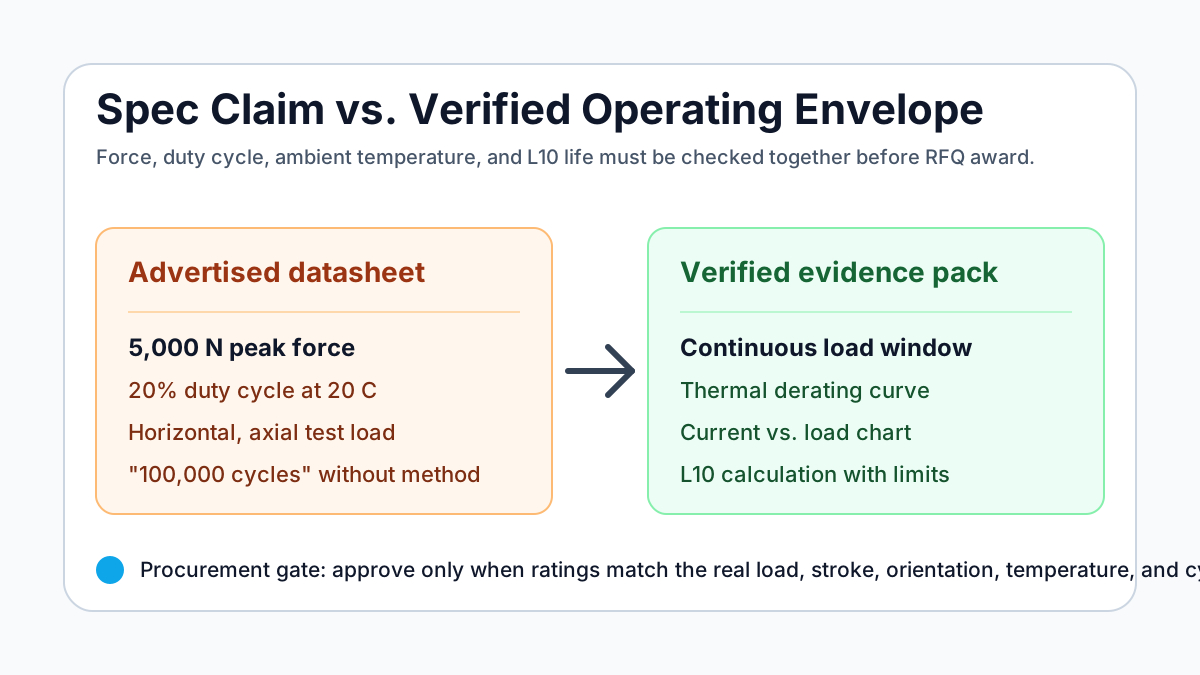
Linear Actuator Spec Inflation: A Procurement Guide to Verifying Force, Duty Cycle, and Lifespan Ratings
Verify linear actuator force, duty cycle, and L10 life claims before RFQ award. Use supplier evidence checks to avoid inflated specs and early failures.