Linear Actuator Spec Inflation: A Procurement Guide to Verifying Force, Duty Cycle, and Lifespan Ratings
Verify linear actuator force, duty cycle, and L10 life claims before RFQ award. Use supplier evidence checks to avoid inflated specs and early failures.
How to Verify Linear Actuator Force, Duty Cycle, and Lifespan Claims
Last Updated: July 25, 2026
Executive Conclusion: "Spec inflation"—where actuator performance ratings are optimized for narrow, ideal laboratory conditions—is a leading cause of premature mechanical failure in industrial automation. Procurement teams and engineering leads must look beyond top-line marketing numbers and demand empirical data, including L10 lifespan analysis, thermal derating curves, and continuous load profiles, to ensure reliable B2B sourcing.
In the competitive landscape of industrial components, the specifications listed on a standard datasheet rarely tell the whole story. As the market floods with low-cost imports, many resellers rely on "spec inflation" to win RFQs. They highlight absolute peak capacities that the linear actuator can only sustain for a fraction of a second under perfect conditions. This guide is designed for buyers, procurement teams, distributors, importers, and engineers who need a rigorous framework to validate actuator specifications and select suppliers who deliver true reliability.
Scope and limits: This is a global procurement and engineering screening guide for custom electric linear actuator sourcing. It does not replace final machine-safety review, supplier-specific sizing software, paid standards access, or destructive endurance testing. Use it before RFQ award, source change approval, and production release when force, duty cycle, ingress rating, or lifespan claims materially affect warranty risk.
Start here: Pair this review with the OEM Linear Actuator RFQ Checklist, IP54 vs IP67 vs IP69K selection guide, and a continuous-duty actuator sizing review before sending edge cases to contact engineering.
1. The Reality of Spec Inflation in the Actuator Market
When sourcing electric linear actuators, the primary variables are force (load capacity), speed, duty cycle, and lifespan. However, how these variables are tested varies wildly between Tier-1 manufacturers and generic resellers.
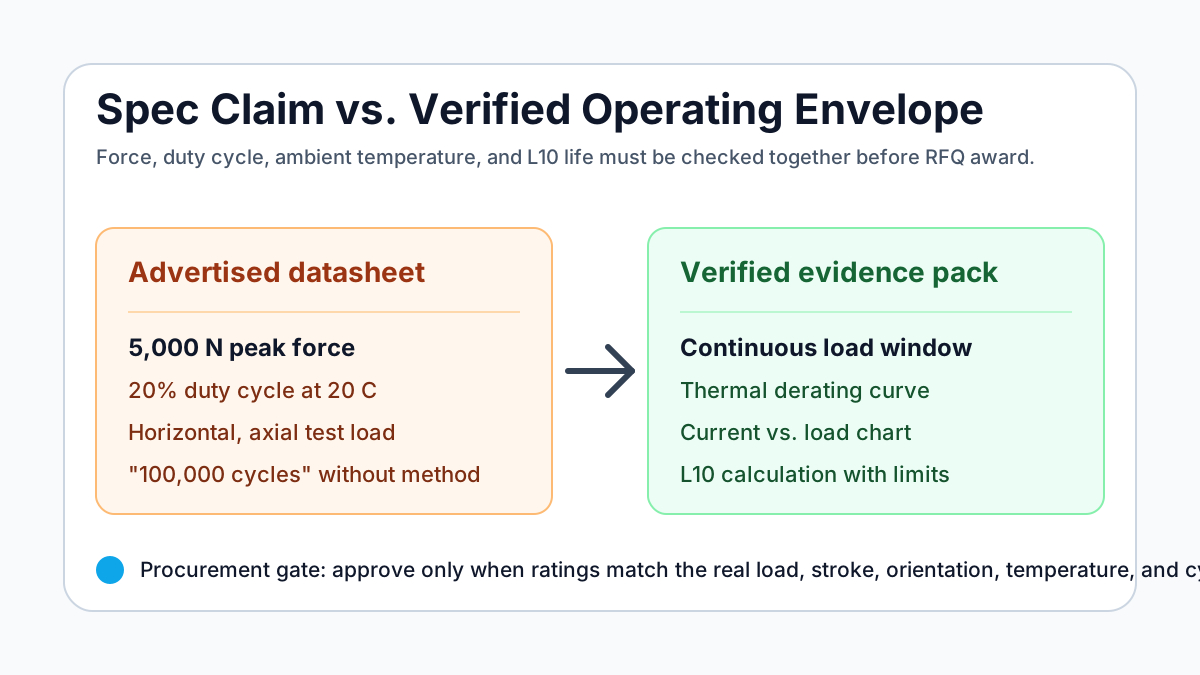
A common scenario in OEM procurement: An engineering team specifies a 5,000 N load requirement with a 20% duty cycle. Procurement sources a low-cost actuator rated for exactly "5,000 N / 20% Duty Cycle." Within three months of deployment in an un-air-conditioned factory, 40% of the units suffer motor burnout or stripped gears.
The failure wasn't a defect; it was a misinterpretation of inflated specs. The manufacturer tested the 5,000 N rating at 20°C ambient temperature, purely in a horizontal orientation, with zero side load, for a maximum of two minutes. The real-world application was 35°C, vertical orientation, with mild vibration.
2. Deconstructing Force Ratings: Peak vs. Continuous Load
The most frequently inflated metric is the force rating. Manufacturers often advertise the Peak Force or Static Load as the primary capability.
- Static Load Capacity: The maximum force the actuator can hold when it is completely stationary (unpowered, with brakes engaged or self-locking threads). It does not indicate moving capability.
- Dynamic Load Capacity (Peak): The absolute maximum weight the actuator can push or pull for a very brief period before stalling or tripping thermal protection.
- Continuous Operating Load: The load the actuator can consistently move throughout its entire rated duty cycle without overheating.
The Evidence: Operating an actuator at 100% of its rated peak dynamic load drastically reduces its lifespan. For industrial applications, procurement should treat 1.5x to 2x as a starting safety-factor screen, then require supplier calculations for the exact screw, bearing, motor, gearbox, stroke, and ambient temperature.
3. The Duty Cycle Trap
Duty cycle is a thermal limit. It represents the ratio of "on-time" to "cooling time." A standard 25% duty cycle means the actuator can move for 2.5 minutes, followed by 7.5 minutes of rest (in a 10-minute window).
The Trap: Spec sheets often assume a laboratory ambient temperature of 20°C to 25°C (68°F to 77°F). If your actuator is installed inside a metal housing on a factory floor where the ambient temperature reaches 40°C (104°F), a 25% duty cycle rating is practically invalid. The heat cannot dissipate fast enough, causing the motor coils to degrade.
Lab Conditions vs. Real-World Variables
| Specification Category | Lab Testing Condition (Datasheet) | Real-World Variable (Application) | Required Procurement Action |
|---|---|---|---|
| Ambient Temperature | 20°C - 25°C (Standard AC) | 35°C - 50°C (Industrial floor, outdoors) | Demand thermal derating curves; apply 10-15% duty cycle reduction per 10°C rise. |
| Load Orientation | Perfectly axial, horizontal | Vertical lifting, off-center mounting | Calculate for gravity, side-loads, and moment loads. Overspecify force by 1.5x. |
| Power Supply | Clean, highly regulated DC power | Voltage drops over long cable runs | Request current vs. load charts to size wiring and power supplies correctly. |
| Environmental | Clean room, zero contamination | Dust, water washdowns, metal shavings | Verify IP ratings (IP67/IP69K) and request third-party lab testing certificates. |
| Duty Cycle Window | Intermittent (e.g., 2 mins on, 8 mins off) | Short, rapid pulses (e.g., 5 secs on/10 off) | Rapid start/stops generate high inrush current heat; consult engineering for custom windings. |
| Lifespan | Ideal cycle counts without stress | Real mechanical fatigue | Request L10 bearing and screw life calculations, not just "estimated" cycles. |
4. L10 Lifespan Analysis: Statistical Proof vs. Marketing Promises
When a datasheet says "Lifespan: 100,000 cycles," it is often an arbitrary marketing number. In industrial procurement, you must rely on L10 Life Calculations.
Derived from ISO 281 standards for rolling bearings, the L10 life is a statistical calculation representing the number of revolutions (or distance traveled) that 90% of a group of identical actuators will achieve or exceed before the first evidence of fatigue develops.
The Evidence: A reputable manufacturer uses the dynamic load rating of their specific ball screw or lead screw, combined with your application's actual load, to calculate the L10 lifespan in kilometers or millions of inches. If a vendor cannot produce an L10 calculation for their heavy-duty actuators, they are likely reselling commercial-grade components masquerading as industrial-grade.
5. Method & Boundaries: Risks and Trade-offs
While rigorous specification verification is critical, it must be balanced against project constraints:
- Cost vs. Over-specification: The temptation after learning about spec inflation is to massively over-spec every actuator (e.g., buying a 10,000 N actuator for a 2,000 N job). This wastes budget and significantly increases the physical footprint and power requirements of the machine. The goal is accurate sizing, not excessive sizing.
- Lead Times for Certified Data: Demanding extensive custom environmental testing or empirical thermal curves for a low-volume order may result in vendors declining to quote, or significantly extending lead times. Use these rigorous checks primarily for critical OEM production runs, high-volume sourcing, or high-risk applications.
6. OEM Engineering & Procurement Validation Checklist
Do not finalize an RFQ without running through this vendor validation checklist:
- Safety Factor Application: Have we multiplied our maximum operating load by at least 1.5x to determine the target dynamic load rating?
- Thermal Derating: If operating above 25°C, have we requested the manufacturer's thermal derating curve to adjust the duty cycle?
- L10 Calculation: Has the vendor provided a verifiable L10 lifespan calculation based on our specific load and stroke profile?
- Current Draw Limits: Have we verified the maximum current draw at full load to ensure our control system and relays won't trip?
- Static vs. Dynamic Force: Does the quote clearly separate holding force (static) from pushing/pulling force (dynamic)?
- Side Load Analysis: Have we eliminated side-loading in our mechanical design, or specified linear guides to absorb non-axial forces?
7. Frequently Asked Questions (FAQ)
Q: How can I quickly spot a vendor who is inflating their specs? A: Look at the relationship between speed, force, and current. If a vendor claims a very high force and high speed but lists an abnormally low maximum current draw (e.g., 24V DC / 3 Amps for 5,000 N at 20mm/s), the laws of physics dictate the numbers are likely fabricated. Mechanical power requires electrical power.
Q: Our actuator only moves occasionally, but holds a massive load. Which spec matters? A: Static load capacity. You need an actuator with a robust self-locking lead screw or an internal mechanical brake that can safely hold the weight without power.
Q: Does IP rating affect the duty cycle? A: Yes. Higher IP ratings (like IP67 or IP69K) require tighter seals and completely enclosed housings. This traps heat generated by the motor. A fully sealed actuator may have a lower duty cycle limit than a comparable unsealed actuator because it lacks ventilation.
Q: Can we run an actuator at 100% duty cycle? A: Only if it is explicitly designed for continuous duty. Standard DC brush motors and lead screws cannot handle 100% duty cycle due to friction and heat. Continuous duty requires brushless DC (BLDC) or servo motors paired with high-efficiency ball screws or roller screws.
8. Conclusion & Next Steps
Combating spec inflation requires a shift from passive reading of datasheets to active engineering validation. By demanding transparent L10 calculations, understanding thermal derating, and applying appropriate safety factors, procurement teams can protect their supply chains from premature component failure and costly machine downtime.
The cheapest actuator on paper often becomes the most expensive component on the factory floor when replacement labor and lost production are factored in.
Need a technical partner who prioritizes engineering transparency?
Contact our engineering team to discuss your application parameters, request verifiable L10 lifecycle data, or send an RFQ-ready actuator packet sized for your real-world environment.
9. Verifiable Sources & References
- ISO 281:2007: Rolling bearings — Dynamic load ratings and rating life. Use this as the formal reference point for L10/life language and the 90% reliability boundary; it also states that wear, corrosion, and electrical erosion are outside the ISO 281 life calculation. ISO Publications
- NEMA Enclosure Types: Official NEMA guidance for enclosure type selection. Use it to prevent buyers from treating an enclosure label as proof of corrosion, icing, washdown chemistry, or moving-cable sealing performance. NEMA Enclosure Types PDF
- NEMA MG 1 FAQ: Official NEMA motor-standard interpretation notes. Use it as a pointer that motor ratings, starts, insulation, voltage, and frequency assumptions must be checked instead of inferred from a reseller actuator datasheet. NEMA MG 1 FAQ
- NEMA Motor Standards vs. IEC Motor Standards: Official NEMA comparison of NEMA MG 1 and IEC motor standards. Use it when actuator suppliers mix NEMA/IEC motor language in quotations or datasheets. NEMA PDF
Author

Categories
More Posts
Linear Actuator Market Update (2026-W17): Mexico Aluminum Import Notice, U.S. Full-Value 232, and Sourcing Controls
Week 17 brief for custom linear actuator buyers: Mexico aluminum notice and U.S. full-value 232 updates, plus RFQ and sourcing controls to apply before PO release.
Linear Actuator Market Update (2026-W18): U.S. Aluminum Extrusion AD/CVD Review Signals and RFQ Controls
Week 18 brief for custom linear actuator buyers: U.S. aluminum extrusion AD/CVD signals and RFQ controls to limit cost, lead-time, and compliance surprises.
Linear Actuator Market Update (2026-W27): Proclamation 11032 Shifts Section 232 Tariff Thresholds and RFQ Sourcing Strategies
Week 27 brief for custom linear actuator buyers: Proclamation 11032 lowers the U.S.-origin metal threshold to 85%; update RFQs and HTS evidence before award.